Holiday Survival Guide: Protecting Your Mental Health Without Opting Out
How to Get Through the Holidays Without Burning Yourself Out
The holidays are often painted as this warm, cozy, joy-filled time of year. And sometimes, they are exactly that. But for many people, the holidays also bring stress, emotional overload, complicated family dynamics, grief, financial pressure, and unrealistic expectations.
If you’ve ever found yourself counting down the minutes until an event ends, feeling guilty for not being happier, or wondering why this season feels harder than it “should,” you’re not alone.
This holiday survival guide isn’t about forcing gratitude, pretending everything is fine, or opting out of the season altogether. It’s about learning how to move through the holidays in a way that protects your mental health, honors your limits, and leaves room for both joy and heaviness.
Why the Holidays Can Feel So Emotionally Heavy
Before we jump into strategies, it helps to understand why the holidays can feel so intense.
1. Heightened Expectations
There’s often pressure to be joyful, grateful, social, generous, and emotionally present, all at once. That’s a lot to ask of anyone.
2. Family Dynamics
Old roles, unresolved conflicts, and emotional triggers have a way of resurfacing when everyone is back together.
3. Grief and Loss
Holidays can amplify grief, whether you’ve lost a loved one, a relationship, or the version of life you thought you’d have by now.
4. Disrupted Routines
Sleep schedules, eating habits, exercise, and downtime often get thrown off, which directly impacts mental health.
5. Sensory and Social Overload
Crowded rooms, constant noise, small talk, and back-to-back plans can overwhelm even the most social people.
If the holidays feel hard, it’s not because you’re doing something wrong, it’s because this season asks a lot.
Holiday Survival Starts With Permission
One of the most important things you can give yourself during the holidays is permission.
Permission to:
Have limits
Feel mixed emotions
Say no without overexplaining
Step away before you’re overwhelmed
Not process everything in real time
You don’t need to earn rest, boundaries, or space. You’re allowed to need them simply because you’re human.
Decide Ahead of Time What You’re Not Available For
This is one of the most powerful holiday mental health tools—and one of the most overlooked.
Instead of deciding in the moment (when emotions are high), ask yourself before the holidays:
What conversations am I not willing to engage in?
How many events can I realistically attend?
What topics or dynamics tend to dysregulate me?
What drains me the fastest?
Examples of Boundaries You Can Set Ahead of Time
“I’m not available for political debates.”
“I’m not staying past a certain time.”
“I’m not explaining my life choices.”
“I’m not attending every event.”
Deciding ahead of time reduces guilt, anxiety, and emotional whiplash.
Let Awkward Moments Pass Without Fixing Them

This one is especially important for people-pleasers and overthinkers.
Not every awkward silence needs to be filled.
Not every comment needs a response.
Not every uncomfortable moment needs to be smoothed over.
Sometimes the healthiest response is… doing nothing.
Letting awkward moments pass without fixing them:
Preserves your energy
Reduces resentment
Interrupts people-pleasing patterns
You are not responsible for managing everyone else’s comfort.
Build in Transition Time Between Events
Back-to-back plans might look efficient on a calendar, but emotionally, they’re exhausting.
Transition time gives your nervous system a chance to reset.
What Transition Time Can Look Like
Sitting in your car for 10 minutes before going inside
Taking a short walk between events
Listening to music or a grounding podcast
Deep breathing or stretching
Think of transition time as emotional decompression, not wasted time.
Step Away Before You’re Overwhelmed
Many people wait until they’re already flooded before stepping away. By then, irritability, shutdown, or anxiety has already kicked in.
Try noticing your early signs of overwhelm:
Feeling tense or irritable
Zoning out
Shortness of breath
Urge to escape or shut down
Stepping outside or into another room before overwhelm peaks can make a huge difference.
You don’t need a dramatic exit. A simple “I’m going to grab some air” is enough.
Not Everything Needs to Be Processed in Real Time

This is a big one, especially for emotionally aware people.
Just because something triggers you doesn’t mean you need to analyze it right now.
Processing can wait.
Reflection can wait.
Meaning-making can wait.
Sometimes the most regulated choice is saying:
“I’ll come back to this later.”
You Can Hold Joy and Heaviness at the Same Time
This might be the most important holiday reminder of all.
You can:
Laugh and still miss someone
Enjoy a moment and still feel sad
Be grateful and still overwhelmed
Show up and still struggle
Holding joy and heaviness at the same time doesn’t mean you’re ungrateful. It means you’re honest.
A Quick Holiday Survival Breakdown
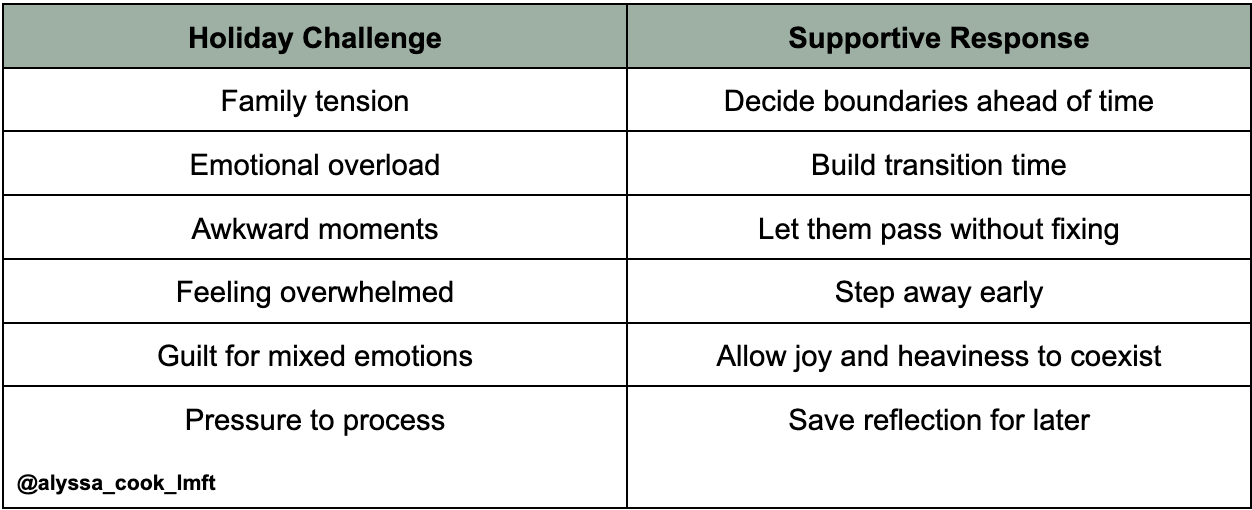
Managing Family Dynamics Without Losing Yourself
Family gatherings often activate old patterns.
You might notice yourself:
Slipping into old roles
Over-explaining
Freezing or fawning
Feeling like a younger version of yourself
None of that means you’ve “regressed.” It means your nervous system recognizes familiar dynamics.
Helpful Reminders
You don’t need to prove you’ve changed
You don’t need to educate anyone
You don’t need to win or convince
Sometimes the most powerful growth is responding differently—or not responding at all.

Lower the Bar (Seriously)
Holiday expectations tend to be wildly unrealistic.
Your home doesn’t need to look perfect.
Every tradition doesn’t need to be honored.
Every event doesn’t need your full energy.
Lowering the bar doesn’t mean you don’t care, it means you care about your well-being.
What If the Holidays Are Especially Hard This Year?
Some seasons hit harder than others.
If you’re navigating:
Grief
Infertility or pregnancy loss
Postpartum challenges
Relationship changes
Burnout or depression
It makes sense if this time feels heavier.
You’re allowed to opt for gentler holidays. Smaller plans. Quieter moments. More space.
How Therapy Can Support You During the Holidays
Therapy during the holidays isn’t just for crisis moments, it can be a grounding anchor.
A therapist can help you:
Prepare for triggering situations
Practice boundary-setting
Process grief and loss
Regulate anxiety and overwhelm
Release guilt around “shoulds”
Sometimes having a place to land after the holidays is just as important as preparing for them.

Surviving the Holidays Counts
You don’t need to love the holidays.
You don’t need to feel constant joy.
You don’t need to do it perfectly.
Getting through the season while staying connected to yourself counts.
If this year’s goal is simply to survive the holidays with a little more self-compassion and a little less self-abandonment, that’s more than enough.
And if you need support navigating this season, you don’t have to do it alone.