
Holiday Survival Guide: Protecting Your Mental Health Without Opting Out
The holidays can bring joy, connection, and meaning—but they can also bring stress, grief, overwhelm, and pressure. This holiday survival guide offers realistic ways to protect your mental health while staying grounded, present, and true to yourself.
How to Get Through the Holidays Without Burning Yourself Out

The holidays are often painted as this warm, cozy, joy-filled time of year. And sometimes, they are exactly that. But for many people, the holidays also bring stress, emotional overload, complicated family dynamics, grief, financial pressure, and unrealistic expectations.
If you’ve ever found yourself counting down the minutes until an event ends, feeling guilty for not being happier, or wondering why this season feels harder than it “should,” you’re not alone.
This holiday survival guide isn’t about forcing gratitude, pretending everything is fine, or opting out of the season altogether. It’s about learning how to move through the holidays in a way that protects your mental health, honors your limits, and leaves room for both joy and heaviness.
Why the Holidays Can Feel So Emotionally Heavy
Before we jump into strategies, it helps to understand why the holidays can feel so intense.
1. Heightened Expectations
There’s often pressure to be joyful, grateful, social, generous, and emotionally present, all at once. That’s a lot to ask of anyone.
2. Family Dynamics
Old roles, unresolved conflicts, and emotional triggers have a way of resurfacing when everyone is back together.
3. Grief and Loss
Holidays can amplify grief, whether you’ve lost a loved one, a relationship, or the version of life you thought you’d have by now.
4. Disrupted Routines
Sleep schedules, eating habits, exercise, and downtime often get thrown off, which directly impacts mental health.
5. Sensory and Social Overload
Crowded rooms, constant noise, small talk, and back-to-back plans can overwhelm even the most social people.
If the holidays feel hard, it’s not because you’re doing something wrong, it’s because this season asks a lot.
Holiday Survival Starts With Permission
One of the most important things you can give yourself during the holidays is permission.
Permission to:
Have limits
Feel mixed emotions
Say no without overexplaining
Step away before you’re overwhelmed
Not process everything in real time
You don’t need to earn rest, boundaries, or space. You’re allowed to need them simply because you’re human.
Decide Ahead of Time What You’re Not Available For
This is one of the most powerful holiday mental health tools—and one of the most overlooked.
Instead of deciding in the moment (when emotions are high), ask yourself before the holidays:
What conversations am I not willing to engage in?
How many events can I realistically attend?
What topics or dynamics tend to dysregulate me?
What drains me the fastest?
Examples of Boundaries You Can Set Ahead of Time
“I’m not available for political debates.”
“I’m not staying past a certain time.”
“I’m not explaining my life choices.”
“I’m not attending every event.”
Deciding ahead of time reduces guilt, anxiety, and emotional whiplash.
Let Awkward Moments Pass Without Fixing Them

This one is especially important for people-pleasers and overthinkers.
Not every awkward silence needs to be filled.
Not every comment needs a response.
Not every uncomfortable moment needs to be smoothed over.
Sometimes the healthiest response is… doing nothing.
Letting awkward moments pass without fixing them:
Preserves your energy
Reduces resentment
Interrupts people-pleasing patterns
You are not responsible for managing everyone else’s comfort.
Build in Transition Time Between Events
Back-to-back plans might look efficient on a calendar, but emotionally, they’re exhausting.
Transition time gives your nervous system a chance to reset.
What Transition Time Can Look Like
Sitting in your car for 10 minutes before going inside
Taking a short walk between events
Listening to music or a grounding podcast
Deep breathing or stretching
Think of transition time as emotional decompression, not wasted time.
Step Away Before You’re Overwhelmed
Many people wait until they’re already flooded before stepping away. By then, irritability, shutdown, or anxiety has already kicked in.
Try noticing your early signs of overwhelm:
Feeling tense or irritable
Zoning out
Shortness of breath
Urge to escape or shut down
Stepping outside or into another room before overwhelm peaks can make a huge difference.
You don’t need a dramatic exit. A simple “I’m going to grab some air” is enough.
Not Everything Needs to Be Processed in Real Time

This is a big one, especially for emotionally aware people.
Just because something triggers you doesn’t mean you need to analyze it right now.
Processing can wait.
Reflection can wait.
Meaning-making can wait.
Sometimes the most regulated choice is saying:
“I’ll come back to this later.”
You Can Hold Joy and Heaviness at the Same Time
This might be the most important holiday reminder of all.
You can:
Laugh and still miss someone
Enjoy a moment and still feel sad
Be grateful and still overwhelmed
Show up and still struggle
Holding joy and heaviness at the same time doesn’t mean you’re ungrateful. It means you’re honest.
A Quick Holiday Survival Breakdown
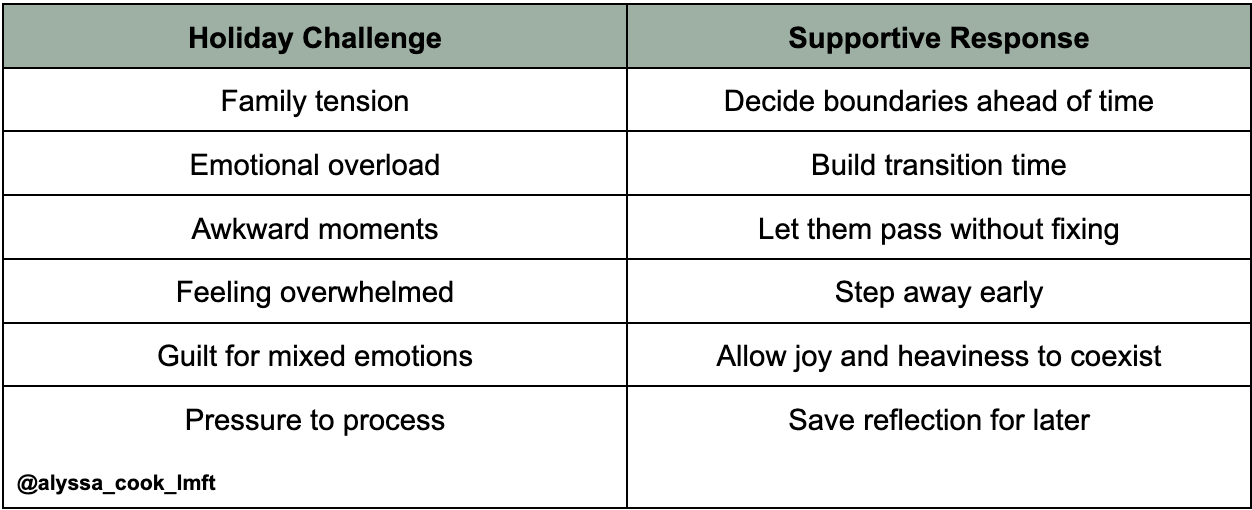
Managing Family Dynamics Without Losing Yourself
Family gatherings often activate old patterns.
You might notice yourself:
Slipping into old roles
Over-explaining
Freezing or fawning
Feeling like a younger version of yourself
None of that means you’ve “regressed.” It means your nervous system recognizes familiar dynamics.
Helpful Reminders
You don’t need to prove you’ve changed
You don’t need to educate anyone
You don’t need to win or convince
Sometimes the most powerful growth is responding differently—or not responding at all.

Lower the Bar (Seriously)
Holiday expectations tend to be wildly unrealistic.
Your home doesn’t need to look perfect.
Every tradition doesn’t need to be honored.
Every event doesn’t need your full energy.
Lowering the bar doesn’t mean you don’t care, it means you care about your well-being.
What If the Holidays Are Especially Hard This Year?
Some seasons hit harder than others.
If you’re navigating:
Grief
Infertility or pregnancy loss
Postpartum challenges
Relationship changes
Burnout or depression
It makes sense if this time feels heavier.
You’re allowed to opt for gentler holidays. Smaller plans. Quieter moments. More space.
How Therapy Can Support You During the Holidays
Therapy during the holidays isn’t just for crisis moments, it can be a grounding anchor.
A therapist can help you:
Prepare for triggering situations
Practice boundary-setting
Process grief and loss
Regulate anxiety and overwhelm
Release guilt around “shoulds”
Sometimes having a place to land after the holidays is just as important as preparing for them.

Surviving the Holidays Counts
You don’t need to love the holidays.
You don’t need to feel constant joy.
You don’t need to do it perfectly.
Getting through the season while staying connected to yourself counts.
If this year’s goal is simply to survive the holidays with a little more self-compassion and a little less self-abandonment, that’s more than enough.
And if you need support navigating this season, you don’t have to do it alone.

Quieting the Inner Critic: How to Shift Your Self-Talk and Build Self-Compassion
Your inner critic is that harsh voice in your head that says you're not good enough. Learn how to identify it, respond with self-compassion, and develop a healthier inner dialogue.
Understanding Your Inner Critic and How to Talk Back

We all have that voice in our head—the one that chimes in when we mess up, feel unsure, or try something new. “You’re not good enough.” “Why did you say that?” “You’ll never get it right.” This voice is often referred to as the inner critic, and while it might sound like it’s trying to keep us safe, it often causes more harm than good.
In this blog, we’ll unpack what the inner critic is, where it comes from, and how to respond to it differently. We’ll also explore the empowering alternative: the inner coach. If you're ready to turn down the volume on self-judgment and turn up the self-compassion, you're in the right place.
What Is the Inner Critic?
The inner critic is the internal voice that judges, shames, and doubts us. It’s the part of our mind that points out our flaws, magnifies our mistakes, and predicts failure. The inner critic might sound like:
“You always mess things up.”
“Why can’t you be more like them?”
“No one is going to take you seriously.”
Where Does the Inner Critic Come From?

The inner critic often develops early in life as a way to cope with difficult environments or meet the expectations of caregivers, teachers, or society. While it may have once served a protective purpose, it tends to become overactive and unhelpful in adulthood.
Common sources of the inner critic include:
Childhood criticism or unrealistic expectations
Trauma or neglect
Cultural or societal pressures
Perfectionism
The Impact of the Inner Critic on Mental Health
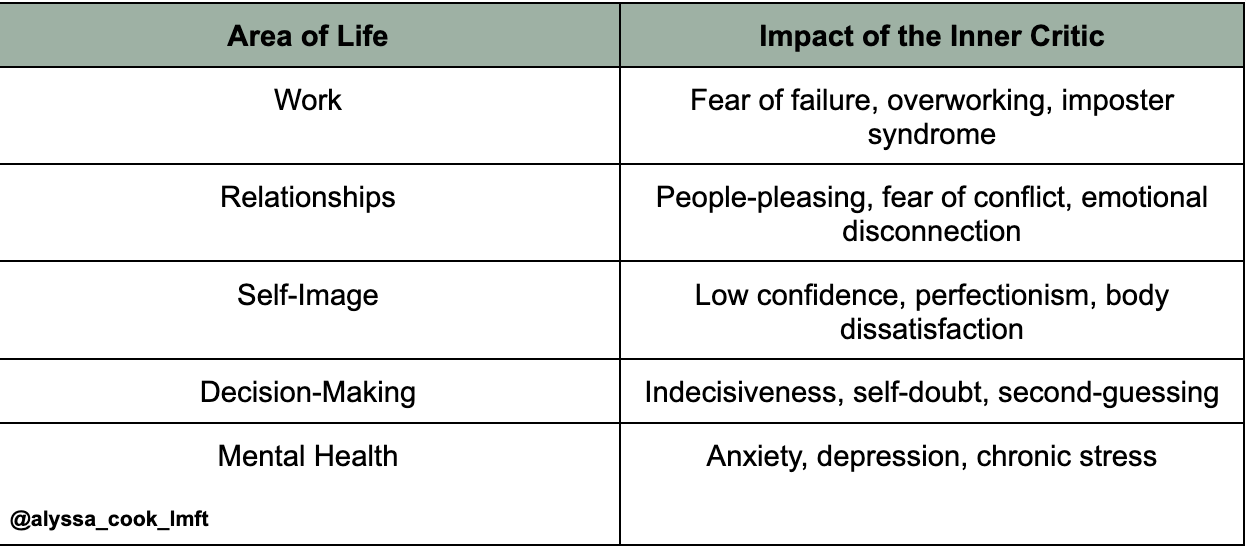
When left unchecked, the inner critic can fuel issues like anxiety, depression, low self-esteem, and burnout. It can keep you stuck in fear, people-pleasing, or procrastination.
How the Inner Critic Affects You
Recognizing the Voice of Your Inner Critic
The first step in healing your relationship with your inner voice is becoming aware of it. Start noticing when your self-talk is harsh, judgmental, or unkind. Ask yourself:
Would I say this to someone I care about?
Does this voice motivate me—or shut me down?
Where did I learn to talk to myself this way?
Keeping a journal or thought log can be a powerful tool to bring these thoughts into the light.
Inner Critic vs. Inner Coach
Let’s introduce a healthier voice: the inner coach. Unlike the inner critic, the inner coach is supportive, realistic, and encouraging. It doesn’t pretend everything is perfect—it just doesn’t tear you down.
Key Differences
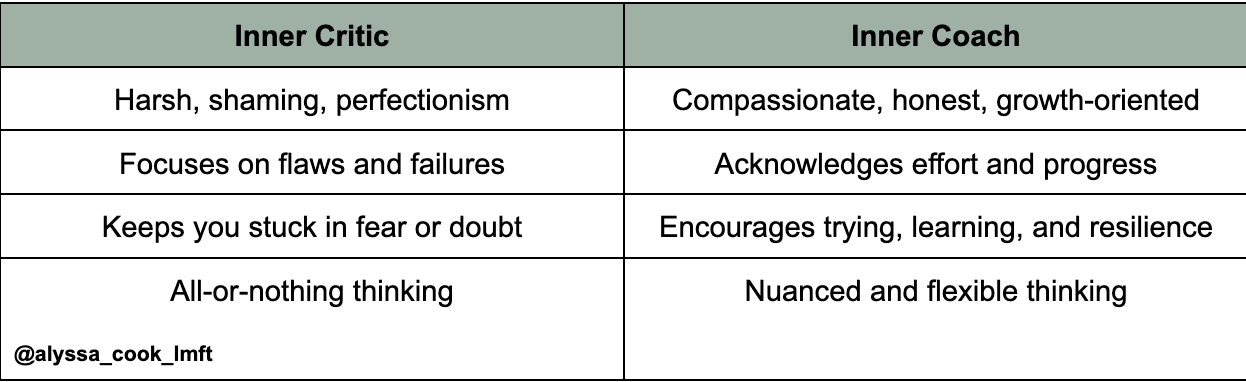
You can start to shift your inner narrative by learning how to replace critical thoughts with more compassionate ones.
How to Respond Differently: Practical Strategies
Changing your inner dialogue takes time and practice, but it’s absolutely possible. Here are some techniques that can help:
1. Name Your Inner Critic
Give it a name or identity—like "The Perfectionist," "The Worrier," or even something playful like “Judgey McJudgeface.” Naming helps you create some distance and notice when it's showing up.
2. Use the ABC Model
Adapted from CBT (Cognitive Behavioral Therapy):
A – Activating event: Something happens (e.g., you make a mistake at work)
B – Belief: “I’m terrible at my job.”
C – Consequence: You feel anxious and avoid taking initiative
Challenge the belief by asking: What’s the evidence for and against this? What would I say to a friend in this situation?
3. Reframe the Thought
Reframe “I always fail” into “This was hard, but I’m learning.” Turn “I’m not enough” into “I’m doing the best I can right now.”
4. Practice Self-Compassion
This means speaking to yourself with kindness, especially when things don’t go as planned. Try:
“It’s okay to make mistakes.”
“This is tough, and I’m not alone.”
“I can learn and grow from this.”
5. Talk Back in Writing
Write a letter from your inner critic—and then write a letter in response from your inner coach or compassionate self. This is a powerful exercise to externalize the negative voice and offer yourself support.
6. Use Affirmations (That Actually Work for You)
Not cheesy, fake-positive ones—but grounded ones that resonate. Try:
“I am learning to be kind to myself.”
“Progress matters more than perfection.”
“I can hold space for my flaws and my strengths.”
When the Inner Critic Gets Loud: Triggers to Watch For

Certain situations can make the inner critic more vocal. Being aware of these can help you catch it in action.
Common triggers include:
Transitions (new job, new relationship)
Feedback or perceived failure
Social comparison
High-stress or burnout
Feeling emotionally vulnerable
Notice your patterns—then bring in your inner coach.
How Therapy Can Help
You don’t have to navigate this work alone. A therapist can help you:
Recognize and challenge core beliefs
Understand the origins of your inner critic
Build a toolbox of self-compassion and coping skills
Practice skills like thought reframing and self-validation
Modalities like CBT, IFS (Internal Family Systems), and ACT (Acceptance and Commitment Therapy) are especially helpful when working with the inner critic.
Small Daily Practices to Rewire Your Inner Dialogue
Healing your inner narrative doesn’t happen overnight—but consistent, gentle practice makes a difference. Try adding some of these into your routine:
Start your day with a grounding affirmation
Take 60 seconds to notice and name your thoughts
Journal one thing you’re proud of each day
End your day with a self-compassion check-in: “What did I need today that I didn’t get?”
Final Thoughts: You Are Not Your Inner Critic

The inner critic might always be part of your mental landscape—but it doesn’t have to take the wheel. With awareness, practice, and support, you can build a new way of relating to yourself that’s rooted in compassion and courage.
You are not broken for having an inner critic. You are human. And you have the power to choose a different voice—the voice of your inner coach, your wise self, your compassionate inner healer.
If you’re ready to get support in quieting your inner critic and building a stronger, more supportive inner voice, therapy can be a powerful place to start. Reach out if you’d like to talk more!

The Power of CBT: How It Works and Who Can Benefit
Struggling with anxious thoughts or unhelpful habits? Cognitive Behavioral Therapy (CBT) is a powerful, evidence-based approach that helps people change negative thought patterns and behaviors. Whether you're dealing with anxiety, depression, or just everyday stress, CBT can be a game-changer. Read on to learn how it works and who can benefit from it.
What Is Cognitive Behavioral Therapy (CBT) and How Can It Help?

If you’ve ever found yourself stuck in negative thought loops or unhealthy behavioral patterns, you’re not alone. Life can be overwhelming, and sometimes our minds get caught up in unhelpful cycles. That’s where Cognitive Behavioral Therapy (CBT) comes in.
CBT is a structured, goal-oriented form of talk therapy that helps people identify and change unhelpful thinking patterns. Unlike traditional talk therapy, which might explore past experiences in-depth, CBT focuses on practical strategies you can use right now to shift your thoughts and behaviors for the better.
Let’s break it down further to understand how it works and who it’s best for.
How Does CBT Work?
At its core, CBT is based on the idea that our thoughts, emotions, and behaviors are interconnected. If we can change one, we can influence the others. Here’s how the process typically unfolds:
1. Identifying Negative Thought Patterns
The first step in CBT is recognizing problematic thoughts. For example, if you often think, “I’m not good enough,” that belief can lead to feelings of anxiety and behaviors like avoiding challenges. A therapist helps you pinpoint these automatic negative thoughts.
2. Challenging and Restructuring Thoughts
Once negative thought patterns are identified, CBT teaches you how to challenge them. You’ll learn to ask yourself questions like:

Is this thought based on facts or assumptions?
What evidence do I have that this thought is true or false?
How would I talk to a friend who had this thought?
3. Behavioral Changes and Coping Strategies
Thoughts influence behaviors, so the next step is adjusting actions. This may involve:
Practicing exposure therapy for fears and anxieties
Developing healthier coping mechanisms for stress
Learning problem-solving skills to address challenges directly
4. Practicing and Reinforcing New Skills
CBT isn’t just about talking—it’s about taking action. Clients often get “homework” like journaling their thoughts, trying new behaviors, or practicing mindfulness exercises.
Who Can Benefit from CBT?
CBT is one of the most researched and effective forms of therapy, and it can help with a wide range of mental health concerns, including:


What to Expect in a CBT Session
A typical CBT session is structured and collaborative. You won’t just be venting about your problems—you and your therapist will actively work together on solutions. Here’s what a session might look like:
1. Checking In
The therapist will ask how you’ve been since your last session and review any homework assignments.
2. Identifying Key Issues
Together, you’ll decide what specific thoughts or behaviors to focus on during the session.
3. Learning and Practicing New Skills
Your therapist may introduce techniques like cognitive restructuring (changing negative thoughts) or relaxation exercises.
4. Homework and Goal Setting
CBT is action-oriented, so you’ll often leave with strategies to practice in your daily life.
How Long Does CBT Take?
Unlike some therapies that continue indefinitely, CBT can be more short-term. Many people see significant progress in 12 to 20 sessions, though this varies depending on individual needs. Some may benefit from fewer sessions, while others may continue CBT for maintenance.
Can You Practice CBT on Your Own?

Absolutely! While working with a therapist is the most effective approach, there are ways to incorporate CBT techniques into your daily life, such as:
Keeping a thought journal
Practicing mindfulness and deep breathing
Challenging negative thoughts with logical questioning
Setting small, achievable goals for behavior change
Is CBT Right for You?
If you’re looking for a structured, practical approach to improving your mental health, CBT might be a great fit. It’s especially helpful if you prefer actionable steps over just talking about emotions.
If you’re interested in exploring CBT with a therapist, I’d love to help you get started. Feel free to click the button below to schedule a free consultation to see if CBT is the right approach for you!

Burnout, Stress, or Depression? Understanding the Differences and How to Cope
Feeling exhausted, overwhelmed, or emotionally drained? You’re not alone. But how do you know if you’re dealing with burnout, stress, or depression? Understanding the differences can help you find the right coping strategies. Let’s dive into the key signs of each and explore ways to regain balance.
Recognizing the Signs: Burnout, Stress, or Depression?

Life can be overwhelming, and at times, it feels like we’re carrying more than we can handle. But how do you know if you’re just stressed, experiencing burnout, or struggling with depression? The lines between them can get blurry, especially when exhaustion becomes the norm. Understanding the difference is key to figuring out what you need to feel better. In this blog, we’ll break down what each of these experiences looks like, how they impact your mental health, and what steps you can take to recover and regain balance.
Why Understanding the Difference Matters
Life can get overwhelming, and we’ve all felt drained at some point. But when does stress turn into burnout, and when does burnout shift into depression? Knowing the difference is crucial because each requires a different approach. Let’s break it down so you can recognize what’s going on and take the right steps toward healing.
What is Stress?
Stress is the everyday pressure we all feel. Stress is a normal part of life. It’s your body’s reaction to a challenge, whether it’s a big work deadline, an argument with a loved one, or financial worries. A little stress can be motivating, pushing us to meet goals or solve problems. But when it becomes chronic stress, it starts to wear us down.
Signs of Stress
Feeling irritable or anxious
Trouble sleeping
Racing thoughts or overthinking
Physical tension (headaches, muscle pain, stomach issues)
Increased heart rate
Difficulty concentrating

How to Manage Stress
Prioritize self-care: Make time for activities that relax you, like reading, walking, or listening to music.
Set boundaries: Learn to say no when your plate is too full.
Practice deep breathing: Techniques like box breathing or progressive muscle relaxation can help calm your nervous system.
Get organized: Break tasks into manageable steps and avoid last-minute pressure.
What Is Burnout?
Burnout is when stress becomes too much for too long. Burnout happens when stress is left unchecked for too long. It’s not just feeling tired—it’s a deeper emotional, physical, and mental exhaustion caused by prolonged work-related stress, caregiving, or even emotional labor in relationships.
Signs of Burnout
Feeling emotionally drained or detached
Lack of motivation, even for things you used to enjoy
Increased cynicism or negativity
Trouble concentrating or making decisions
Frequent illnesses due to a weakened immune system
Feeling ineffective or unaccomplished
How to Recover from Burnout
Take a break: Even short breaks during the day can help reset your brain.
Reevaluate your workload: Delegate tasks and adjust unrealistic expectations.
Set clear work-life boundaries: Avoid answering emails after hours.
Find joy outside of work: Hobbies, socializing, and downtime are essential for recovery.
What Is Depression?

Depression is when the darkness won’t lift. Unlike stress or burnout, depression is a mental health condition that affects your overall mood, thoughts, and daily functioning. It isn’t just a response to external pressure—it can persist even when there’s no obvious trigger. Depression requires professional support and treatment.
Signs of Depression
Persistent sadness or emptiness
Loss of interest in things you once enjoyed
Fatigue, even after rest
Feelings of worthlessness or guilt
Changes in appetite or weight
Difficulty concentrating
Thoughts of self-harm or suicide
How to Seek Help for Depression
Talk to a therapist: Professional support can provide coping strategies and treatment options.
Consider medication if needed: A doctor or psychiatrist can help determine if medication is right for you.
Reach out to loved ones: Social support is crucial, even if you don’t feel like engaging.
Practice self-compassion: Depression isn’t a choice, and it’s okay to ask for help.
Burnout, Stress, or Depression? How to Tell the Difference
Sometimes the lines between stress, burnout, and depression blur. Here’s a quick way to differentiate them:

When to Seek Professional Help

If you feel like stress is controlling your life, burnout is making you dread daily tasks, or depression is making it hard to get through the day, it’s time to seek help. You don’t have to figure it out alone.
Therapy can help you:
✅ Identify the root cause of your distress
✅ Develop personalized coping strategies
✅ Create a sustainable work-life balance
✅ Improve overall mental well-being
You Deserve Support
Life can be overwhelming, but you don’t have to navigate burnout, stress, or depression alone. Recognizing the signs is the first step, and reaching out for support is the next. Whether you need self-care, boundaries, or professional help, taking action now can set you on the path to a healthier, more balanced life.

Understanding the Window of Tolerance: Managing Emotional Overwhelm with Compassion
Feeling overwhelmed by emotions is a common human experience, but understanding the window of tolerance can help you navigate those intense moments with greater ease. In this blog, we’ll explore what the window of tolerance is, how it impacts your mental health, and practical strategies to stay within it.

Understanding Your Window of Tolerance and Managing Overwhelm
Life has its fair share of challenges, and sometimes emotions can feel like they’re running the show. You’re not alone if you’ve found yourself overreacting in stressful situations or feeling completely numb when things get tough. These are signs that you might be operating outside your window of tolerance, a concept in mental health that can help explain emotional overwhelm.
Let’s dive into what the window of tolerance is, how it works, and how you can expand it to better handle life’s ups and downs.
What Is the Window of Tolerance?
The window of tolerance is a term introduced by Dr. Dan Siegel, a renowned psychiatrist, to describe the range in which we can function and respond to life’s stressors with relative ease. When we’re within our window, we feel calm, connected, and capable of handling challenges.
But when stress becomes overwhelming, we can shift out of this zone into two extremes:
Hyperarousal: This is when your emotions are in overdrive. Think panic, anxiety, anger, or feeling out of control.
Hypoarousal: This is the opposite, where you shut down emotionally, feel numb, or disconnect entirely from yourself and others.
Both states are natural responses to stress, but consistently living outside your window can take a toll on your mental health and well-being.
Why Understanding Your Window of Tolerance Matters
Being aware of your window of tolerance isn’t just a helpful mental health concept—it’s a game-changer for self-awareness and emotional regulation. It helps you:
Recognize your triggers: Knowing what pushes you into hyperarousal or hypoarousal can help you prepare and respond more effectively.
Develop coping skills: Once you know where your limits are, you can build tools to stay within your window.
Foster healthier relationships: Staying regulated allows you to communicate more effectively and build stronger connections with others.
Signs You’re Outside Your Window of Tolerance
It’s not always obvious when you’re outside your window. Here are some common signs to watch for:

Hyperarousal:
Racing thoughts or constant worry
Difficulty concentrating
Irritability or outbursts of anger
Physical symptoms like a racing heart or shallow breathing
Hypoarousal:
Feeling disconnected or “checked out”
Low energy or motivation
Difficulty remembering things
Numbness or lack of emotional response
Recognizing these signs is the first step in managing emotional overwhelm.
Strategies to Stay Within Your Window of Tolerance
Here’s the good news: Your window of tolerance isn’t fixed. With intentional effort, you can expand it and build resilience. Let’s explore some practical strategies.
1. Practice Mindful Awareness
Mindfulness is one of the most effective tools for staying grounded. By tuning into the present moment, you can better recognize when you’re nearing the edges of your window.
Try deep breathing exercises: Inhale for four counts, hold for four counts, and exhale for four counts.
Use grounding techniques: Focus on your five senses to bring yourself back to the present.
2. Build a Daily Routine
Consistency creates stability. A predictable routine can reduce stress and help you stay regulated.
Prioritize sleep, nutrition, and exercise.
Create time for activities that bring you joy, like journaling, reading, or spending time with loved ones.

3. Seek Support from Trusted People
We’re wired for connection, and having a solid support system can help keep us within our window of tolerance.
Share your feelings with friends, family, or a therapist.
Join support groups or communities where you feel understood and validated.
4. Use Self-Compassion
It’s easy to beat yourself up when you’re overwhelmed, but practicing self-compassion can make a huge difference.
Speak to yourself like you would a friend.
Remind yourself that it’s okay to have difficult emotions and that you’re doing your best.
5. Learn Emotional Regulation Skills
Therapeutic tools like cognitive behavioral therapy (CBT) or dialectical behavior therapy (DBT) can help you manage emotions more effectively. A therapist can guide you through these techniques and tailor them to your needs.
Expanding Your Window of Tolerance Over Time
Expanding your window isn’t about eliminating stress but learning how to handle it more effectively. Here are some long-term strategies:
1. Gradual Exposure to Stress
Start by facing small, manageable challenges and gradually work up to bigger ones. This helps your nervous system adapt to stress in a healthy way.
2. Regular Physical Activity
Exercise is a powerful tool for regulating your nervous system. Activities like yoga, walking, or dancing can help release pent-up energy and keep you grounded.
3. Therapy for Deeper Work
Working with a therapist can help you identify underlying patterns and traumas that might keep you outside your window. Techniques like EMDR (Eye Movement Desensitization and Reprocessing) or somatic therapy can be especially helpful.

Managing Emotional Overwhelm in Real Time
Sometimes, stress sneaks up on you, and you find yourself outside your window before you even realize it. Here’s how to handle it in the moment:
Pause and breathe: Focus on slowing your breath to calm your nervous system.
Name your feelings: Acknowledging what you’re feeling can help reduce its intensity.
Engage in a soothing activity: Listen to calming music, take a warm bath, or go for a nature walk.
When to Seek Professional Help
If you’re consistently struggling to stay within your window of tolerance, it might be time to seek professional support. A therapist can help you:
Identify and address the root causes of emotional overwhelm.
Develop personalized strategies for managing stress.
Expand your window of tolerance over time.
Navigating Your Window of Tolerance
Understanding your window of tolerance is a powerful step toward managing emotional overwhelm and building a healthier relationship with yourself. By practicing mindfulness, seeking support, and developing regulation skills, you can navigate life’s challenges with more ease and confidence.
Remember, you’re not alone in this journey. Whether it’s through therapy, support from loved ones, or simple self-care practices, there’s always a way forward.