
Holiday Survival Guide: Protecting Your Mental Health Without Opting Out
The holidays can bring joy, connection, and meaning—but they can also bring stress, grief, overwhelm, and pressure. This holiday survival guide offers realistic ways to protect your mental health while staying grounded, present, and true to yourself.
How to Get Through the Holidays Without Burning Yourself Out

The holidays are often painted as this warm, cozy, joy-filled time of year. And sometimes, they are exactly that. But for many people, the holidays also bring stress, emotional overload, complicated family dynamics, grief, financial pressure, and unrealistic expectations.
If you’ve ever found yourself counting down the minutes until an event ends, feeling guilty for not being happier, or wondering why this season feels harder than it “should,” you’re not alone.
This holiday survival guide isn’t about forcing gratitude, pretending everything is fine, or opting out of the season altogether. It’s about learning how to move through the holidays in a way that protects your mental health, honors your limits, and leaves room for both joy and heaviness.
Why the Holidays Can Feel So Emotionally Heavy
Before we jump into strategies, it helps to understand why the holidays can feel so intense.
1. Heightened Expectations
There’s often pressure to be joyful, grateful, social, generous, and emotionally present, all at once. That’s a lot to ask of anyone.
2. Family Dynamics
Old roles, unresolved conflicts, and emotional triggers have a way of resurfacing when everyone is back together.
3. Grief and Loss
Holidays can amplify grief, whether you’ve lost a loved one, a relationship, or the version of life you thought you’d have by now.
4. Disrupted Routines
Sleep schedules, eating habits, exercise, and downtime often get thrown off, which directly impacts mental health.
5. Sensory and Social Overload
Crowded rooms, constant noise, small talk, and back-to-back plans can overwhelm even the most social people.
If the holidays feel hard, it’s not because you’re doing something wrong, it’s because this season asks a lot.
Holiday Survival Starts With Permission
One of the most important things you can give yourself during the holidays is permission.
Permission to:
Have limits
Feel mixed emotions
Say no without overexplaining
Step away before you’re overwhelmed
Not process everything in real time
You don’t need to earn rest, boundaries, or space. You’re allowed to need them simply because you’re human.
Decide Ahead of Time What You’re Not Available For
This is one of the most powerful holiday mental health tools—and one of the most overlooked.
Instead of deciding in the moment (when emotions are high), ask yourself before the holidays:
What conversations am I not willing to engage in?
How many events can I realistically attend?
What topics or dynamics tend to dysregulate me?
What drains me the fastest?
Examples of Boundaries You Can Set Ahead of Time
“I’m not available for political debates.”
“I’m not staying past a certain time.”
“I’m not explaining my life choices.”
“I’m not attending every event.”
Deciding ahead of time reduces guilt, anxiety, and emotional whiplash.
Let Awkward Moments Pass Without Fixing Them

This one is especially important for people-pleasers and overthinkers.
Not every awkward silence needs to be filled.
Not every comment needs a response.
Not every uncomfortable moment needs to be smoothed over.
Sometimes the healthiest response is… doing nothing.
Letting awkward moments pass without fixing them:
Preserves your energy
Reduces resentment
Interrupts people-pleasing patterns
You are not responsible for managing everyone else’s comfort.
Build in Transition Time Between Events
Back-to-back plans might look efficient on a calendar, but emotionally, they’re exhausting.
Transition time gives your nervous system a chance to reset.
What Transition Time Can Look Like
Sitting in your car for 10 minutes before going inside
Taking a short walk between events
Listening to music or a grounding podcast
Deep breathing or stretching
Think of transition time as emotional decompression, not wasted time.
Step Away Before You’re Overwhelmed
Many people wait until they’re already flooded before stepping away. By then, irritability, shutdown, or anxiety has already kicked in.
Try noticing your early signs of overwhelm:
Feeling tense or irritable
Zoning out
Shortness of breath
Urge to escape or shut down
Stepping outside or into another room before overwhelm peaks can make a huge difference.
You don’t need a dramatic exit. A simple “I’m going to grab some air” is enough.
Not Everything Needs to Be Processed in Real Time

This is a big one, especially for emotionally aware people.
Just because something triggers you doesn’t mean you need to analyze it right now.
Processing can wait.
Reflection can wait.
Meaning-making can wait.
Sometimes the most regulated choice is saying:
“I’ll come back to this later.”
You Can Hold Joy and Heaviness at the Same Time
This might be the most important holiday reminder of all.
You can:
Laugh and still miss someone
Enjoy a moment and still feel sad
Be grateful and still overwhelmed
Show up and still struggle
Holding joy and heaviness at the same time doesn’t mean you’re ungrateful. It means you’re honest.
A Quick Holiday Survival Breakdown
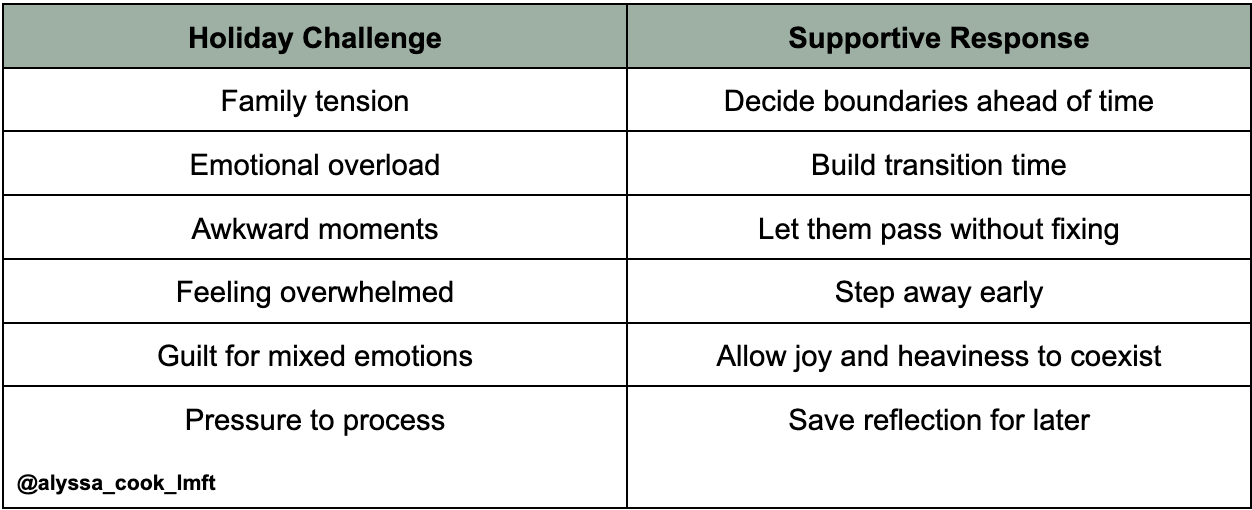
Managing Family Dynamics Without Losing Yourself
Family gatherings often activate old patterns.
You might notice yourself:
Slipping into old roles
Over-explaining
Freezing or fawning
Feeling like a younger version of yourself
None of that means you’ve “regressed.” It means your nervous system recognizes familiar dynamics.
Helpful Reminders
You don’t need to prove you’ve changed
You don’t need to educate anyone
You don’t need to win or convince
Sometimes the most powerful growth is responding differently—or not responding at all.

Lower the Bar (Seriously)
Holiday expectations tend to be wildly unrealistic.
Your home doesn’t need to look perfect.
Every tradition doesn’t need to be honored.
Every event doesn’t need your full energy.
Lowering the bar doesn’t mean you don’t care, it means you care about your well-being.
What If the Holidays Are Especially Hard This Year?
Some seasons hit harder than others.
If you’re navigating:
Grief
Infertility or pregnancy loss
Postpartum challenges
Relationship changes
Burnout or depression
It makes sense if this time feels heavier.
You’re allowed to opt for gentler holidays. Smaller plans. Quieter moments. More space.
How Therapy Can Support You During the Holidays
Therapy during the holidays isn’t just for crisis moments, it can be a grounding anchor.
A therapist can help you:
Prepare for triggering situations
Practice boundary-setting
Process grief and loss
Regulate anxiety and overwhelm
Release guilt around “shoulds”
Sometimes having a place to land after the holidays is just as important as preparing for them.

Surviving the Holidays Counts
You don’t need to love the holidays.
You don’t need to feel constant joy.
You don’t need to do it perfectly.
Getting through the season while staying connected to yourself counts.
If this year’s goal is simply to survive the holidays with a little more self-compassion and a little less self-abandonment, that’s more than enough.
And if you need support navigating this season, you don’t have to do it alone.

Postpartum Depression vs. Normal Adjustment: How to Tell the Difference
Adjusting to life with a newborn is overwhelming for every parent, but how do you know when it’s more than typical stress? This blog breaks down the difference between normal postpartum adjustment and postpartum depression, in a compassionate and relatable way.
Navigating Postpartum Emotions: What’s Normal and What’s Not

Bringing home a new baby is often described as magical, but for many parents, the experience feels more like a roller coaster of exhaustion, mood swings, and overwhelm. Between sleepless nights, endless feeding cycles, and adjusting to a completely new identity, it’s natural to feel off-balance.
But sometimes the struggle goes beyond "normal adjustment." Postpartum depression (PPD) is a real, common, and treatable condition, and knowing the difference matters. In this blog, we’ll explore what’s expected during postpartum recovery, what’s not, and how to tell when you may need extra support.
What Are Normal Postpartum Adjustment Challenges?
The postpartum period (often called the "fourth trimester") is filled with massive emotional, physical, and hormonal changes. Even in the best circumstances, it’s completely normal to experience:
Mood swings
Fatigue and overwhelm
Increased irritability
Crying spells
Self-doubt about parenting
Feeling disconnected from your pre-baby identity
Why These Normal Adjustments Happen

Adjusting to a newborn is demanding for many reasons:
Hormonal fluctuations: After delivery, estrogen and progesterone levels drop dramatically.
Sleep deprivation: Newborns don’t care about your circadian rhythm.
Identity shifts: You’re suddenly responsible for keeping a tiny human alive.
Physical recovery: Whether vaginal birth or C-section, the body is healing.
These challenges can feel overwhelming but typically improve with rest, support, and time.
What Is Postpartum Depression (PPD)?
Postpartum depression is a clinical condition that affects up to 1 in 7 birthing parents. It’s more intense, longer-lasting, and more disruptive than typical postpartum stress.
Common Symptoms of PPD:
Persistent sadness or emptiness
Loss of interest in activities
Difficulty bonding with the baby
Intense guilt or feelings of worthlessness
Anxiety or intrusive thoughts
Hopelessness
Trouble sleeping even when the baby sleeps
Changes in appetite
Thoughts of self-harm or harming the baby
PPD is not your fault. It’s caused by a mix of hormonal, environmental, and psychological factors.
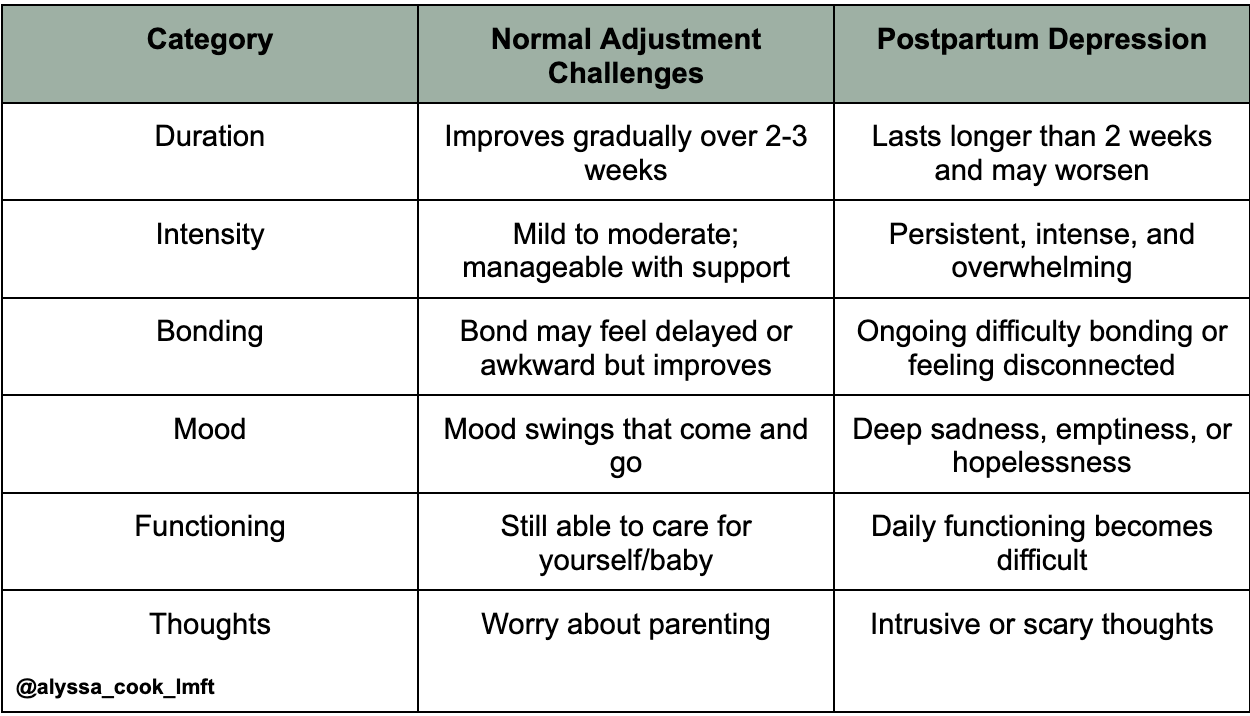
Key Differences: Normal Adjustment vs. Postpartum Depression
Here’s a simple breakdown to help illustrate the differences:
When Should You Seek Help?
If your symptoms:
last longer than two weeks,
interfere with daily functioning,
feel overwhelming or unmanageable,
or you’re experiencing intrusive or scary thoughts, it's time to reach out for help.
PPD is treatable with therapy, medication, support groups, or a combination of these.
Why Some People Are More Prone to PPD
There’s no single cause of postpartum depression, but risk factors include:
History of depression or anxiety
Traumatic birth experience
Lack of support from partner or family
Sleep deprivation
Hormonal sensitivity
NICU stay or medical complications
Previous pregnancy or infant loss
High expectations of self or perfectionism
Understanding these factors can help reduce shame and encourage early support.
How to Support Yourself Through Postpartum Recovery

Learning to care for yourself is essential, not selfish. Here’s how to support emotional health during the postpartum period:
1. Build a Support System
Accept help from friends, family, or postpartum doulas. Delegating tasks doesn’t make you less capable—it makes you human.
2. Prioritize Rest
Even short naps throughout the day can help restore emotional balance.
3. Connect with Other Parents
Support groups or parent-baby classes normalize the experience.
4. Lower Unrealistic Expectations
Your house doesn’t need to be spotless. Your baby doesn’t need a perfect routine. Good enough parenting truly is good enough.
5. Nourish Your Body
Hydration, balanced meals, and gentle movement can impact mood.
6. Create Moments of Self-Compassion
Use simple reminders like:
"I am learning."
"This phase is temporary."
"I deserve support, too."
When You’re Struggling: What Therapy Can Offer
Therapy can be incredibly helpful in the postpartum period, even if you’re not dealing with PPD. Working with a therapist gives you space to process identity changes, fears, relationships, and emotional overwhelm.
Therapists may use modalities like:
CBT to challenge intrusive thoughts
IFS to support overwhelmed internal parts
Mindfulness-based work to reconnect with the body
Emotion-focused therapy to process relationship shifts and communication
A therapist can help you build coping strategies, identify support needs, and reduce shame or isolation.
What About Partners?
Partners can also experience postpartum depression or anxiety, even without giving birth. Signs may include withdrawal, irritability, loss of interest, or feeling overwhelmed. The transition to parenthood impacts the whole family. Encourage partners to seek support if they’re struggling, you don’t have to navigate this alone.
Final Thoughts: You’re Not Failing, You’re Adjusting

Every parent experiences postpartum challenges. What you’re feeling doesn’t make you weak or inadequate, it makes you human. But if what you’re feeling goes beyond normal stress and starts impacting your ability to function, connect, or enjoy life, reaching out for help is one of the most loving things you can do for yourself and your baby. Postpartum depression is treatable, temporary, and nothing to be ashamed of. You deserve support, rest, compassion, and healing. If you're ready to talk to someone who understands postpartum mental health, I'm here to help you navigate this season with care and support.

Why Change Feels Hard: Understanding Your Brain and Learning to Adapt
Struggling to adjust to change? Whether it’s a new job, lifestyle shift, or personal growth, your brain is wired to resist. This blog explains why change feels so hard and offers practical, compassionate strategies to help you adapt more smoothly.
Why Your Brain Resists Change and How to Help It Adjust

We all know change is a part of life, but let’s be real, it often feels really hard. Even when we’re making positive changes, like starting a new job, committing to healthier habits, or moving to a new city, there’s usually a part of us that just wants to run back to the comfort of what we already know. Why does that happen?
The short answer: your brain is wired for safety and predictability, not uncertainty. But here’s the good news is you can learn to work with your brain rather than against it.
In this blog, we’ll explore why your brain struggles with change, how it impacts your daily life, and the practical steps you can take to gently guide yourself through transitions.
Why Does the Brain Resist Change?
Change triggers our brain’s alarm system. Even if a change is positive, your brain may interpret it as a potential threat. Here are the main reasons why:

1. The Comfort of Familiarity
Your brain loves patterns. Familiar routines create a sense of safety because you know what to expect. Breaking a habit, even for something better, means stepping into the unknown.
2. Fear of the Unknown
The brain interprets uncertainty as risky. When you don’t know how things will turn out, your stress response can kick in, flooding your body with anxiety or resistance.
3. Energy Conservation
Creating new neural pathways takes effort. Your brain is always trying to conserve energy, so it prefers sticking to well-worn patterns rather than building new ones.
4. Emotional Associations
If you’ve experienced stressful or painful changes in the past, your brain may associate “change” with danger or loss, even if the current change is safe and positive.
How Resistance to Change Shows Up in Daily Life
When your brain struggles with change, it can look like procrastination, avoidance, or even self-sabotage. Here are some common signs:
Feeling overwhelmed or anxious when thinking about the change
Procrastinating or delaying action
Overthinking or second-guessing decisions
Clinging to old routines even when they no longer serve you
Experiencing physical tension, fatigue, or disrupted sleep
A Gentle Approach: How to Work With Your Brain During Change

The key is not to force yourself into change with willpower alone, but to work gently with your brain’s natural wiring.
1. Start Small
Breaking change into smaller steps helps reduce overwhelm. For example, if you’re trying to start exercising, begin with a 10-minute walk rather than committing to an hour at the gym.
2. Create Predictability Within Change
Even small routines provide a sense of stability. If you’ve moved to a new city, establishing a morning ritual can anchor you while you adjust.
3. Normalize Discomfort
Remind yourself: discomfort doesn’t mean something’s wrong. It just means your brain is adjusting.
4. Use Self-Compassion as a Tool
Instead of criticizing yourself for struggling, acknowledge that resistance is a normal part of growth. Try saying, “It makes sense that this feels hard. I’m learning something new.”
5. Celebrate Progress, Not Perfection
Notice and reward yourself for the small wins. This helps reinforce positive changes and motivates your brain to keep going.
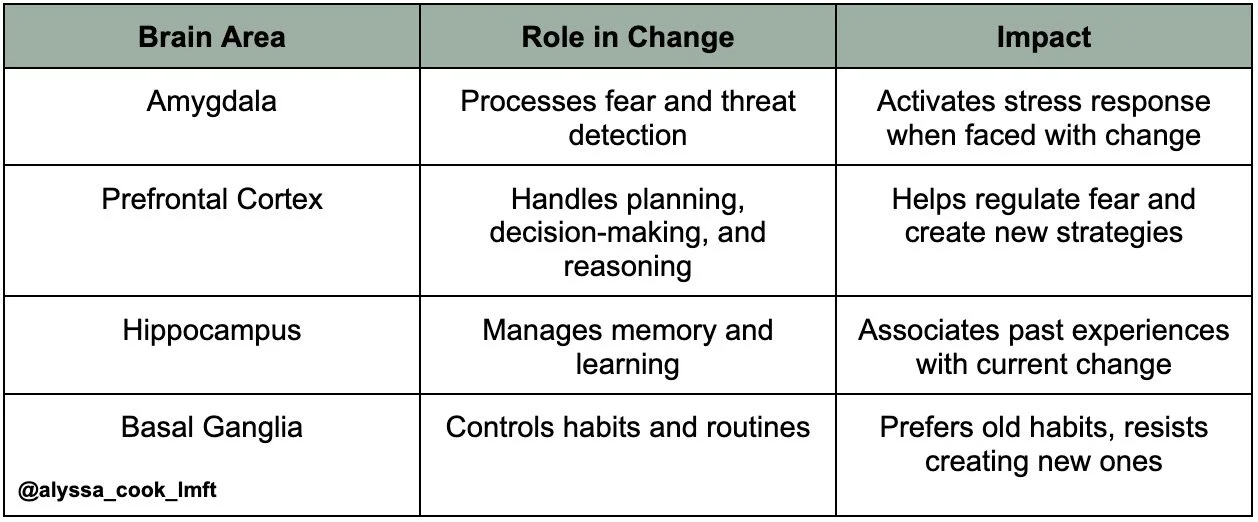
A Look at the Brain’s Response to Change
Here’s a quick breakdown of how the brain processes change:

When Change Feels Overwhelming
Sometimes resistance to change goes beyond everyday discomfort. If you notice that fear or avoidance is deeply interfering with your life, it may be worth seeking support. A therapist can help you:
Understand your resistance more deeply
Build coping strategies tailored to you
Process past experiences that may be influencing your present
You’re Not Broken for Struggling With Change
Struggling with change doesn’t mean you’re weak or incapable, it means you’re human. Your brain is doing its best to keep you safe, even if it sometimes works against your goals. By approaching change with patience, compassion, and practical strategies, you can re-train your brain to embrace growth while still feeling grounded.
So the next time you feel resistance bubbling up, take a deep breath. Remind yourself: It’s okay that this feels hard. Then, choose one small step forward. That’s how change becomes not just possible, but sustainable.

Quieting the Inner Critic: How to Shift Your Self-Talk and Build Self-Compassion
Your inner critic is that harsh voice in your head that says you're not good enough. Learn how to identify it, respond with self-compassion, and develop a healthier inner dialogue.
Understanding Your Inner Critic and How to Talk Back

We all have that voice in our head—the one that chimes in when we mess up, feel unsure, or try something new. “You’re not good enough.” “Why did you say that?” “You’ll never get it right.” This voice is often referred to as the inner critic, and while it might sound like it’s trying to keep us safe, it often causes more harm than good.
In this blog, we’ll unpack what the inner critic is, where it comes from, and how to respond to it differently. We’ll also explore the empowering alternative: the inner coach. If you're ready to turn down the volume on self-judgment and turn up the self-compassion, you're in the right place.
What Is the Inner Critic?
The inner critic is the internal voice that judges, shames, and doubts us. It’s the part of our mind that points out our flaws, magnifies our mistakes, and predicts failure. The inner critic might sound like:
“You always mess things up.”
“Why can’t you be more like them?”
“No one is going to take you seriously.”
Where Does the Inner Critic Come From?

The inner critic often develops early in life as a way to cope with difficult environments or meet the expectations of caregivers, teachers, or society. While it may have once served a protective purpose, it tends to become overactive and unhelpful in adulthood.
Common sources of the inner critic include:
Childhood criticism or unrealistic expectations
Trauma or neglect
Cultural or societal pressures
Perfectionism
The Impact of the Inner Critic on Mental Health
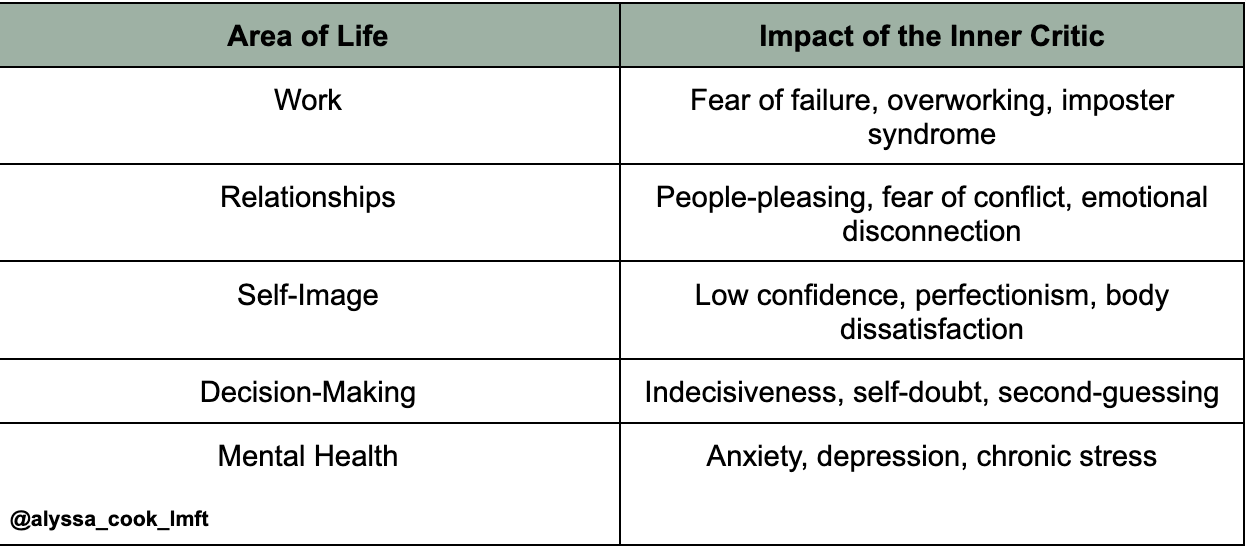
When left unchecked, the inner critic can fuel issues like anxiety, depression, low self-esteem, and burnout. It can keep you stuck in fear, people-pleasing, or procrastination.
How the Inner Critic Affects You
Recognizing the Voice of Your Inner Critic
The first step in healing your relationship with your inner voice is becoming aware of it. Start noticing when your self-talk is harsh, judgmental, or unkind. Ask yourself:
Would I say this to someone I care about?
Does this voice motivate me—or shut me down?
Where did I learn to talk to myself this way?
Keeping a journal or thought log can be a powerful tool to bring these thoughts into the light.
Inner Critic vs. Inner Coach
Let’s introduce a healthier voice: the inner coach. Unlike the inner critic, the inner coach is supportive, realistic, and encouraging. It doesn’t pretend everything is perfect—it just doesn’t tear you down.
Key Differences
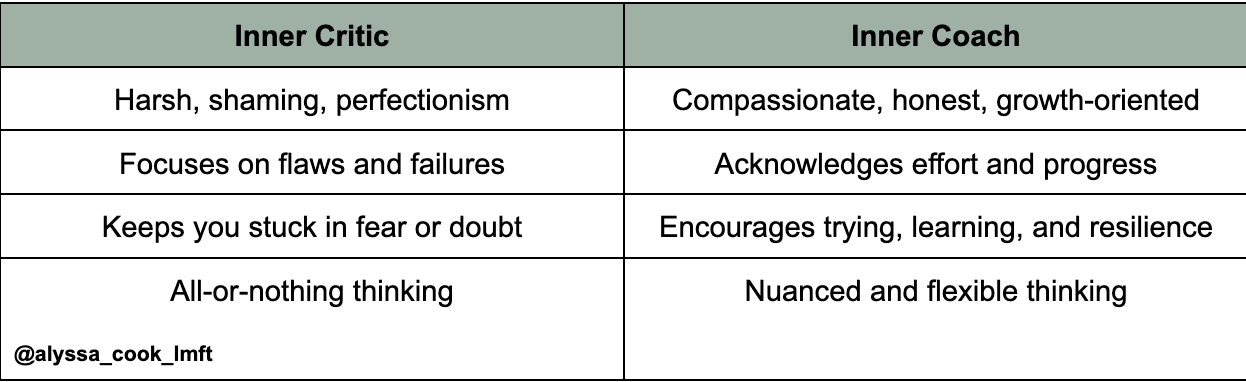
You can start to shift your inner narrative by learning how to replace critical thoughts with more compassionate ones.
How to Respond Differently: Practical Strategies
Changing your inner dialogue takes time and practice, but it’s absolutely possible. Here are some techniques that can help:
1. Name Your Inner Critic
Give it a name or identity—like "The Perfectionist," "The Worrier," or even something playful like “Judgey McJudgeface.” Naming helps you create some distance and notice when it's showing up.
2. Use the ABC Model
Adapted from CBT (Cognitive Behavioral Therapy):
A – Activating event: Something happens (e.g., you make a mistake at work)
B – Belief: “I’m terrible at my job.”
C – Consequence: You feel anxious and avoid taking initiative
Challenge the belief by asking: What’s the evidence for and against this? What would I say to a friend in this situation?
3. Reframe the Thought
Reframe “I always fail” into “This was hard, but I’m learning.” Turn “I’m not enough” into “I’m doing the best I can right now.”
4. Practice Self-Compassion
This means speaking to yourself with kindness, especially when things don’t go as planned. Try:
“It’s okay to make mistakes.”
“This is tough, and I’m not alone.”
“I can learn and grow from this.”
5. Talk Back in Writing
Write a letter from your inner critic—and then write a letter in response from your inner coach or compassionate self. This is a powerful exercise to externalize the negative voice and offer yourself support.
6. Use Affirmations (That Actually Work for You)
Not cheesy, fake-positive ones—but grounded ones that resonate. Try:
“I am learning to be kind to myself.”
“Progress matters more than perfection.”
“I can hold space for my flaws and my strengths.”
When the Inner Critic Gets Loud: Triggers to Watch For

Certain situations can make the inner critic more vocal. Being aware of these can help you catch it in action.
Common triggers include:
Transitions (new job, new relationship)
Feedback or perceived failure
Social comparison
High-stress or burnout
Feeling emotionally vulnerable
Notice your patterns—then bring in your inner coach.
How Therapy Can Help
You don’t have to navigate this work alone. A therapist can help you:
Recognize and challenge core beliefs
Understand the origins of your inner critic
Build a toolbox of self-compassion and coping skills
Practice skills like thought reframing and self-validation
Modalities like CBT, IFS (Internal Family Systems), and ACT (Acceptance and Commitment Therapy) are especially helpful when working with the inner critic.
Small Daily Practices to Rewire Your Inner Dialogue
Healing your inner narrative doesn’t happen overnight—but consistent, gentle practice makes a difference. Try adding some of these into your routine:
Start your day with a grounding affirmation
Take 60 seconds to notice and name your thoughts
Journal one thing you’re proud of each day
End your day with a self-compassion check-in: “What did I need today that I didn’t get?”
Final Thoughts: You Are Not Your Inner Critic

The inner critic might always be part of your mental landscape—but it doesn’t have to take the wheel. With awareness, practice, and support, you can build a new way of relating to yourself that’s rooted in compassion and courage.
You are not broken for having an inner critic. You are human. And you have the power to choose a different voice—the voice of your inner coach, your wise self, your compassionate inner healer.
If you’re ready to get support in quieting your inner critic and building a stronger, more supportive inner voice, therapy can be a powerful place to start. Reach out if you’d like to talk more!

Breaking Free: How to Heal from People-Pleasing Tendencies
Always saying yes even when you want to say no? People-pleasing can lead to exhaustion, resentment, and a loss of self-identity. This blog will guide you through understanding why you people-please and how to break free from the habit with confidence.
Learning to Put Yourself First: Healing from People-Pleasing

If you often find yourself saying yes when you want to say no, avoiding conflict at all costs, or constantly seeking approval, you might struggle with people-pleasing tendencies. While it’s great to be kind and helpful, constantly putting others before yourself can lead to exhaustion, resentment, and a loss of self-identity.
The good news? You can heal from people-pleasing tendencies and start living life on your own terms. Let’s explore why we people-please, how it affects us, and the steps to break free from this exhausting cycle.
Why Do We People-Please?
People-pleasing isn’t just about being nice—it’s often a learned survival strategy. Here are some common reasons why people develop this habit:
1. Fear of Rejection or Abandonment
Many people-pleasers grew up in environments where approval was conditional. Saying no felt like a risk of losing love or acceptance.
2. Avoidance of Conflict
Keeping the peace can feel easier than expressing disagreement, especially if conflict in the past led to stress or emotional pain.
3. Low Self-Worth
If you don’t believe your needs are as important as others’, you might feel obligated to prioritize them over yourself.
4. External Validation
When your self-esteem relies on making others happy, it can feel impossible to say no without guilt.
5. Cultural or Societal Expectations
Some cultures and upbringings emphasize self-sacrifice, making people-pleasing feel like an obligation rather than a choice.
The Costs of People-Pleasing
While being accommodating can seem positive, chronic people-pleasing has consequences:

How to Stop People-Pleasing and Start Prioritizing Yourself

Healing from people-pleasing doesn’t mean becoming selfish—it means learning to value yourself just as much as you value others. Here’s how you can start:
1. Identify Your Patterns
Pay attention to when and why you say yes. Are you agreeing out of genuine willingness, or do you feel pressured?
2. Challenge Your Beliefs
Ask yourself:
What will actually happen if I say no?
Do I believe my worth depends on making others happy?
Am I sacrificing my well-being for someone else’s comfort?
3. Practice Saying No
Start small—decline a minor request and notice that the world doesn’t fall apart. Use gentle but firm language:
"I appreciate the invite, but I need some time for myself."
"That sounds great, but I’m unable to take that on right now."
"I can’t help this time, but I hope it goes well!"
4. Set Boundaries with Confidence
Boundaries protect your energy and emotional well-being. Remember:
Boundaries aren’t mean—they’re necessary.
You don’t need to explain or justify your no.
Saying no allows you to say yes to things that truly matter to you.
5. Prioritize Your Own Needs
Ask yourself regularly:
What do I need right now?
Am I honoring my own limits?
Is this decision serving me as well as others?
6. Let Go of Guilt
It’s okay if people are disappointed by your no. Their feelings are not your responsibility—your well-being is.
7. Seek Support

A therapist can help you work through deep-rooted patterns and build confidence in setting boundaries.
You Deserve to Take Up Space
People-pleasing may have once been a way to feel safe and accepted, but it doesn’t have to define you. Learning to prioritize yourself isn’t selfish—it’s self-respect.
The next time you feel compelled to say yes when you want to say no, pause. Check in with yourself. Give yourself permission to make decisions that serve you.
You deserve relationships and commitments that feel balanced, fulfilling, and healthy. And that starts with you saying yes to yourself.

Why It's Okay to Say No: Learning the Art of Graceful Boundaries
Saying no isn’t selfish—it’s necessary. Setting boundaries can help protect your time, energy, and mental well-being. In this guide, we’ll explore why it’s okay to say no, how to set boundaries without guilt, and ways to communicate them with confidence and kindness.

The Power of No: Why Setting Boundaries is Healthy and Necessary
If you’ve ever felt guilty for saying no, you’re not alone. Many of us struggle with setting boundaries, worried that we’ll disappoint others or come across as unkind. But the truth is, saying no is one of the healthiest things you can do for yourself and your relationships.
Boundaries aren’t about shutting people out—they’re about protecting your time, energy, and emotional well-being. They allow you to show up as your best self rather than feeling overextended, resentful, or burned out.
Let’s explore why setting boundaries is essential, how to do it without guilt, and ways to communicate them with confidence.
Why Do We Struggle to Say No?
1. Fear of Disappointing Others
Many people feel that saying no means letting others down. But constantly saying yes when you don’t want to can lead to frustration and exhaustion.
2. Wanting to Be Liked
It’s natural to want to be liked, but if pleasing others comes at the expense of your own well-being, it’s time to reassess your priorities.
3. Guilt and Obligation
We’re often conditioned to believe that saying no is rude or selfish. In reality, healthy boundaries create stronger relationships built on mutual respect.
4. Fear of Conflict
Some people avoid saying no because they fear confrontation. However, setting boundaries can often prevent bigger conflicts down the road.
The Benefits of Setting Boundaries
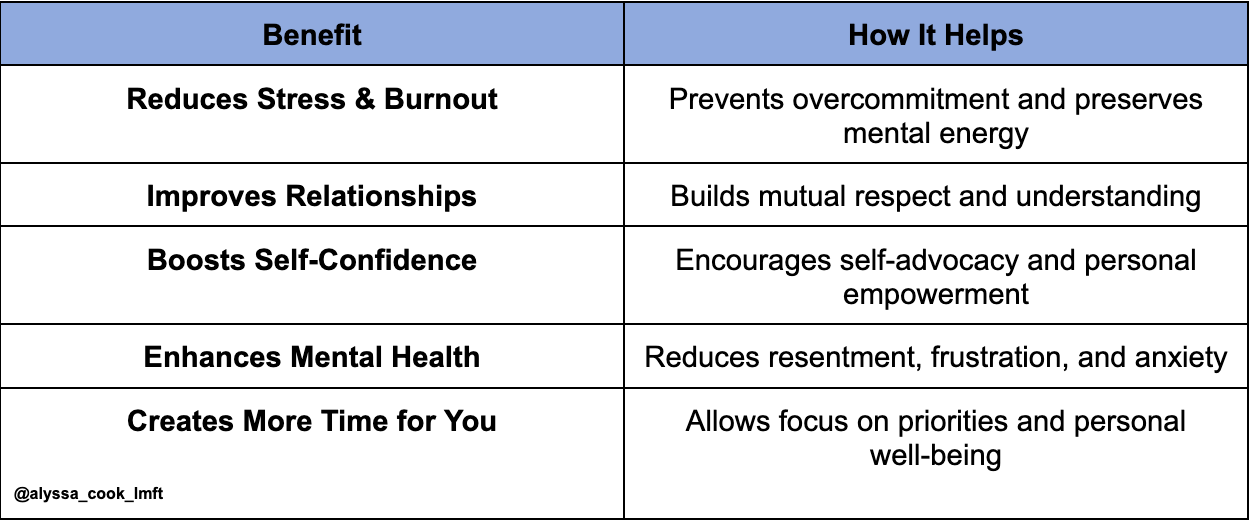
How to Say No Without Guilt
1. Acknowledge Your Feelings

It’s okay to feel uncomfortable at first. Recognize that saying no is an act of self-care, not selfishness.
2. Be Direct but Kind
You don’t have to over-explain. A simple, "I appreciate the offer, but I can’t commit to that right now," is enough.
3. Offer an Alternative (If You Want To)
If you want to help but can’t commit fully, suggest another way: "I can’t make it, but I’d love to catch up another time."
4. Use "I" Statements
Instead of blaming the other person, focus on your needs: "I need some time to recharge, so I won’t be able to join."
5. Practice Saying No
If saying no feels awkward, practice it in low-stakes situations. The more you do it, the easier it becomes.
Examples of Graceful Ways to Say No
"I’d love to, but I’m already committed to something else."
"That sounds great, but I need to prioritize my downtime."
"I appreciate you thinking of me, but I have to pass this time."
"I can’t take that on right now, but I hope it goes well!"
Setting Boundaries in Different Areas of Life
1. Work Boundaries

Declining extra projects that overwhelm you
Setting clear working hours to avoid burnout
Communicating expectations with colleagues
2. Personal Relationships
Saying no to social events when you need alone time
Limiting time with people who drain your energy
Expressing when you need space or emotional support
3. Family Boundaries
Setting limits on how much you’re available for favors
Not feeling pressured to share personal details
Saying no to family expectations that don’t align with your values
4. Digital Boundaries
Taking breaks from social media
Not responding to messages immediately
Limiting screen time for mental well-being
Overcoming the Guilt of Saying No
Guilt often creeps in when we start setting boundaries. Here’s how to move past it:

Remind Yourself Why Boundaries Matter – They protect your well-being.
Know That You Can’t Please Everyone – And that’s okay.
Understand That Others Set Boundaries Too – And you likely respect them.
Reframe "No" as a Form of Self-Respect – It’s about honoring your own needs.
Saying No is Saying Yes to Yourself
Learning to say no isn’t about rejecting others—it’s about choosing yourself. When you set boundaries with confidence and kindness, you create healthier relationships and a more balanced life.
So the next time you feel pressured to say yes, pause and ask yourself: "Is this something I truly want or need to do?" If the answer is no, honor that. You deserve it. Click the button below to set up a free consultation!

The Power of CBT: How It Works and Who Can Benefit
Struggling with anxious thoughts or unhelpful habits? Cognitive Behavioral Therapy (CBT) is a powerful, evidence-based approach that helps people change negative thought patterns and behaviors. Whether you're dealing with anxiety, depression, or just everyday stress, CBT can be a game-changer. Read on to learn how it works and who can benefit from it.
What Is Cognitive Behavioral Therapy (CBT) and How Can It Help?

If you’ve ever found yourself stuck in negative thought loops or unhealthy behavioral patterns, you’re not alone. Life can be overwhelming, and sometimes our minds get caught up in unhelpful cycles. That’s where Cognitive Behavioral Therapy (CBT) comes in.
CBT is a structured, goal-oriented form of talk therapy that helps people identify and change unhelpful thinking patterns. Unlike traditional talk therapy, which might explore past experiences in-depth, CBT focuses on practical strategies you can use right now to shift your thoughts and behaviors for the better.
Let’s break it down further to understand how it works and who it’s best for.
How Does CBT Work?
At its core, CBT is based on the idea that our thoughts, emotions, and behaviors are interconnected. If we can change one, we can influence the others. Here’s how the process typically unfolds:
1. Identifying Negative Thought Patterns
The first step in CBT is recognizing problematic thoughts. For example, if you often think, “I’m not good enough,” that belief can lead to feelings of anxiety and behaviors like avoiding challenges. A therapist helps you pinpoint these automatic negative thoughts.
2. Challenging and Restructuring Thoughts
Once negative thought patterns are identified, CBT teaches you how to challenge them. You’ll learn to ask yourself questions like:

Is this thought based on facts or assumptions?
What evidence do I have that this thought is true or false?
How would I talk to a friend who had this thought?
3. Behavioral Changes and Coping Strategies
Thoughts influence behaviors, so the next step is adjusting actions. This may involve:
Practicing exposure therapy for fears and anxieties
Developing healthier coping mechanisms for stress
Learning problem-solving skills to address challenges directly
4. Practicing and Reinforcing New Skills
CBT isn’t just about talking—it’s about taking action. Clients often get “homework” like journaling their thoughts, trying new behaviors, or practicing mindfulness exercises.
Who Can Benefit from CBT?
CBT is one of the most researched and effective forms of therapy, and it can help with a wide range of mental health concerns, including:


What to Expect in a CBT Session
A typical CBT session is structured and collaborative. You won’t just be venting about your problems—you and your therapist will actively work together on solutions. Here’s what a session might look like:
1. Checking In
The therapist will ask how you’ve been since your last session and review any homework assignments.
2. Identifying Key Issues
Together, you’ll decide what specific thoughts or behaviors to focus on during the session.
3. Learning and Practicing New Skills
Your therapist may introduce techniques like cognitive restructuring (changing negative thoughts) or relaxation exercises.
4. Homework and Goal Setting
CBT is action-oriented, so you’ll often leave with strategies to practice in your daily life.
How Long Does CBT Take?
Unlike some therapies that continue indefinitely, CBT can be more short-term. Many people see significant progress in 12 to 20 sessions, though this varies depending on individual needs. Some may benefit from fewer sessions, while others may continue CBT for maintenance.
Can You Practice CBT on Your Own?

Absolutely! While working with a therapist is the most effective approach, there are ways to incorporate CBT techniques into your daily life, such as:
Keeping a thought journal
Practicing mindfulness and deep breathing
Challenging negative thoughts with logical questioning
Setting small, achievable goals for behavior change
Is CBT Right for You?
If you’re looking for a structured, practical approach to improving your mental health, CBT might be a great fit. It’s especially helpful if you prefer actionable steps over just talking about emotions.
If you’re interested in exploring CBT with a therapist, I’d love to help you get started. Feel free to click the button below to schedule a free consultation to see if CBT is the right approach for you!

From Childhood to Adulthood: How Trauma Shapes the Way We Cope
The experiences we have as children shape the way we see the world, ourselves, and others. Childhood trauma, whether big or small, can influence how we respond to stress, relationships, and emotions in adulthood. This blog explores how early trauma impacts coping mechanisms and how to develop healthier ways of managing life’s challenges.
How Childhood Trauma Shapes Adult Coping Mechanisms

Childhood is where we learn our first lessons about safety, relationships, and how to navigate the world. When those early experiences involve trauma—whether from neglect, abuse, loss, or instability—our brains adapt to protect us. But those adaptations don’t always serve us well in adulthood.
If you’ve ever wondered why you react a certain way to stress, struggle with relationships, or find yourself stuck in unhealthy patterns, your past experiences might hold some answers. Let’s explore how childhood trauma influences adult coping mechanisms and what you can do to build healthier ones.
Understanding Childhood Trauma
Trauma isn’t just about extreme cases like abuse or violence. It can also include experiences such as:
Growing up in a home where emotions weren’t validated
Being frequently criticized or made to feel not good enough
Experiencing a major loss or instability (like frequent moves or parental divorce)
Witnessing conflict or substance abuse
When a child experiences trauma, their brain and nervous system adapt to survive. These adaptations often carry over into adulthood, shaping how they cope with challenges and relationships.
The Connection Between Childhood Trauma and Coping Mechanisms

Our coping mechanisms develop as a response to past experiences. Here’s how childhood trauma can shape different aspects of adult coping:
1. Emotional Regulation
How Trauma Shapes It: Children who grow up in unpredictable environments often develop difficulty managing emotions. They may suppress feelings, overreact, or struggle to identify what they’re feeling at all.
Common Coping Responses: Emotional numbness, emotional outbursts, difficulty expressing needs.
2. Relationships and Attachment
How Trauma Shapes It: Early experiences with caregivers set the foundation for how we connect with others. Trauma can lead to insecure attachment styles, making trust and intimacy difficult.
Common Coping Responses: Avoiding closeness, becoming overly dependent, or engaging in toxic relationship patterns.
3. Stress Response
How Trauma Shapes It: A childhood filled with stress can cause the nervous system to become overly reactive, leading to a heightened fight, flight, or freeze response in adulthood.
Common Coping Responses: Chronic anxiety, perfectionism, procrastination, or avoidance behaviors.
4. Self-Perception and Inner Critic
How Trauma Shapes It: If a child grows up feeling unworthy or not good enough, they may develop negative self-beliefs that persist into adulthood.
Common Coping Responses: Harsh self-criticism, imposter syndrome, fear of failure.
5. Coping Behaviors (Healthy vs. Unhealthy)
Different coping mechanisms can emerge based on childhood experiences. Some promote healing, while others may keep us stuck.

Breaking Free: Developing Healthier Coping Strategies

The good news? Even if childhood trauma shaped your coping mechanisms, you have the power to change them. Here’s how:
1. Identify Your Patterns
Pay attention to how you react to stress, conflict, or difficult emotions. Do you withdraw? Overwork? Get defensive? Recognizing these patterns is the first step toward change.
2. Challenge Negative Beliefs
If you’ve internalized messages like “I’m not good enough” or “I have to do everything perfectly,” start questioning them. Would you say these things to a friend? If not, it’s time to reframe those thoughts.
3. Practice Emotional Awareness
Instead of pushing feelings away, try sitting with them. Ask yourself: What am I feeling right now? Why? Journaling or talking to a therapist can help you process emotions in a healthier way.
4. Build Supportive Relationships
Surround yourself with people who uplift and support you. If unhealthy relationship patterns persist, consider working with a therapist to explore attachment wounds.
5. Develop New Coping Skills

Replacing old habits with healthier ones takes time, but small changes make a big difference. Some effective strategies include:
Mindfulness and meditation
Deep breathing exercises
Physical movement (yoga, walking, dancing)
Engaging in creative outlets (painting, writing, music)
6. Seek Professional Help
Therapy can be a game-changer when it comes to unpacking childhood trauma. A therapist can help you identify deep-rooted patterns and guide you toward healthier coping mechanisms.
Final Thoughts
Your past doesn’t have to define your future. While childhood trauma can shape the way we cope, it doesn’t mean we’re stuck with unhealthy patterns forever. With self-awareness, support, and the right tools, you can develop healthier ways to manage stress, build relationships, and feel more at peace within yourself.
If you’re ready to explore these patterns and create lasting change, therapy can be a powerful step forward. Click the button below to schedule a free consultation!

Breaking the Cycle: Understanding and Overcoming Avoidance Behavior
Avoidance behavior might seem like a way to stay comfortable, but in the long run, it keeps you from growth, success, and emotional well-being. This blog breaks down why we avoid things, how it impacts our lives, and most importantly—what we can do about it.
Why We Avoid Things (And How to Stop)

We all do it—put off difficult conversations, dodge responsibilities, or distract ourselves when things get overwhelming. Avoidance behavior is a natural response to discomfort, but when it becomes a pattern, it can create anxiety, stress, and even bigger problems down the road.
If you’ve ever found yourself deep in a Netflix binge instead of handling an important task, or going out of your way to avoid a difficult situation, this article is for you. Let’s explore what avoidance behavior really is, why we do it, and how to break free from its grip.
What Is Avoidance Behavior?
Avoidance behavior happens when we dodge situations, emotions, or responsibilities that feel uncomfortable or threatening. It’s often linked to anxiety, stress, or past negative experiences, and while it may bring short-term relief, it usually leads to long-term consequences.
Common Types of Avoidance
Avoidance can show up in different ways. Here are a few of the most common forms:

Why Do We Avoid Things?
There are a few psychological reasons why we lean on avoidance behavior. Understanding these can help us begin to shift our habits.

1. Fear of Discomfort or Failure
Many of us avoid things because we anticipate they’ll be uncomfortable or we’re afraid we won’t do well. This is especially true for tasks that require effort, vulnerability, or uncertainty.
2. Anxiety and Overwhelm
When our brains perceive something as stressful, they trigger a fight-or-flight response. Avoidance is a form of “flight.” By dodging the situation, we feel temporary relief, but the stress often comes back stronger later.
3. Habit and Conditioning
If we’ve been avoiding difficult things for a long time, it becomes second nature. We don’t even think about it—we just automatically dodge situations that seem tough.
4. Negative Past Experiences
If something went badly in the past, we may unconsciously avoid similar situations in the future. For example, if you failed a big test in school, you might avoid taking on new learning opportunities as an adult.
The Consequences of Avoidance
Avoidance may feel good in the moment, but it can have some serious downsides, including:
Increased Anxiety – The more we avoid something, the scarier it feels over time.
Missed Opportunities – Avoiding challenges means missing chances for growth and success.
Strained Relationships – Avoiding conflict or difficult conversations can lead to unresolved issues.
More Stress in the Long Run – Problems don’t go away just because we ignore them. They often get worse.

How to Break the Cycle of Avoidance

If avoidance has been holding you back, the good news is that you can break the cycle. Here’s how:
1. Start Small
Tackling big fears head-on can feel overwhelming, so start with small steps. If you avoid phone calls, try answering one today. If you dodge difficult conversations, start with a text or email.
2. Name Your Avoidance
Awareness is the first step to change. Notice when you’re avoiding something and say it out loud: “I’m avoiding this because it feels uncomfortable.” This simple act can help you take control.
3. Challenge Your Thoughts
Ask yourself: What’s the worst that could happen? and How likely is that really? Our brains often exaggerate the risks of facing something difficult.
4. Use the “5-Minute Rule”
If you’re avoiding a task, commit to doing it for just five minutes. Often, once you start, it’s easier to keep going.
5. Practice Exposure Therapy
Exposure therapy is a psychological technique that involves gradually facing what you fear in a controlled way. If you’re afraid of public speaking, for example, start by talking in front of a mirror, then to a friend, then a small group.
6. Build Emotional Resilience
Instead of running from uncomfortable emotions, practice sitting with them. Mindfulness, meditation, and journaling can help you become more comfortable with discomfort.
7. Seek Support
If avoidance is significantly impacting your life, therapy can help. A therapist can work with you to uncover the root causes and develop strategies to move forward.

Final Thoughts
Avoidance behavior is common, but it doesn’t have to control your life. By understanding why we avoid things and taking small steps to face discomfort, we can break free from the cycle and start living more fully.
The next time you catch yourself avoiding something, pause and ask: What’s one small step I can take right now? Change doesn’t happen overnight, but every step forward makes a difference.
Need extra support? Working with a therapist can help you navigate avoidance behavior and develop healthier coping strategies. If you're ready to take that step, click the button below to get started!

Your First Therapy Session: What to Expect and How to Feel Comfortable
Starting therapy for the first time? Feeling nervous? You’re not alone! This guide walks you through exactly what to expect in your first therapy session—without the guesswork. Let’s ease those first-session jitters!

Going Into Therapy: What to Expect From Your First Session
So, you’ve booked your first therapy session. That’s a huge step—congrats! But if you’re feeling a little nervous, you’re not alone. It’s completely normal to wonder, What will I talk about? Will my therapist judge me? Is it going to be awkward? Let’s break it all down so you can walk in feeling prepared and confident.
Therapy 101: What Is It Really Like?
Before we get into the details of your first session, let’s talk about therapy in general. Therapy isn’t about lying on a couch while someone silently takes notes. It’s a conversation—a place where you can talk openly, be yourself, and work through whatever’s on your mind with a trained professional. No pressure, no judgment, just support.
What therapy is NOT:
A place where you’ll be forced to talk about things you’re not ready for
A one-size-fits-all experience
A quick fix (healing takes time!)
What therapy IS:
A safe, confidential space
A partnership between you and your therapist
A tool to help you understand yourself better

What to Expect in Your First Therapy Session
A Warm Welcome (Even If It’s Virtual)
Whether you’re meeting in person or online, your therapist will likely greet you in a warm and friendly way. Their goal is to help you feel comfortable, not to interrogate you!
Some Paperwork (But Not Too Much)
Most therapists will start with some intake paperwork (maybe you filled it out before the your initial session), which might include:
Basic personal info
Insurance/payment details (if applicable)
A confidentiality agreement (therapy is a safe space!)
A short questionnaire about your mental health
A No-Pressure Conversation
Your first session is mostly about getting to know you. Your therapist might ask:
What brings you to therapy?
Have you been to therapy before?
What are you hoping to get out of this?
But don’t worry—you don’t need to have all the answers. It’s okay to say, I’m not sure or I just know I need support. Your therapist is there to guide the conversation.
Setting the Tone for Future Sessions
Your therapist might explain their approach and what you can expect moving forward. If you have any questions—about their style, how often you should meet, or anything else—this is the time to ask!
Common Therapy Myths (and the Truth)
Let’s bust some common therapy myths that might be making your nervous:

How to Make the Most of Therapy

Be Honest (Even If It’s Hard!)
Your therapist can only help with what they know. If something feels uncomfortable, it’s okay to say so. Therapy works best when you’re open about your thoughts and feelings.
Give It Time
The first session might not feel life-changing, and that’s okay! Progress takes time. Stick with it and give yourself grace.
Ask Questions
Want to know more about your therapist’s approach? Curious about a technique they use? Ask! Therapy is a two-way street, and your comfort matters.
Remember: There’s No “Right” Way to Do Therapy
Some people talk a lot, some take time to open up. Some cry, some don’t. There’s no perfect way to “do” therapy—just be yourself.
Final Thoughts: You’ve Got This!
Starting therapy is a brave step toward caring for your mental health. It’s okay to feel nervous, but hopefully, now you know what to expect. Your therapist’s job is to make the process as comfortable as possible—so take a deep breath, walk in (or log in), and know you’re in a safe place.
Got questions? Thinking about booking your first session? Click the button below to reach out! Therapy is here to support you—no pressure, no judgment, just a place to start feeling better.

How to Cultivate Resilience in Challenging Times
Feeling overwhelmed by life’s challenges? Resilience isn’t something you’re born with—it’s a skill you can develop.In this blog, we’ll explore practical ways to build emotional strength, shift your mindset, and bounce back from adversity with confidence.

Building Inner Strength: How to Develop Resilience When Life Gets Tough
Life throws curveballs, and sometimes it feels like we just can't catch a break. Whether it’s personal loss, career setbacks, or global crises, tough times are inevitable. But here’s the good news: resilience is a skill you can build. It’s not about avoiding hardships but learning how to navigate them with strength, flexibility, and a little bit of grace. In this blog, we’ll explore practical ways to cultivate resilience so you can handle life’s ups and downs with more confidence and less stress.
What Is Resilience and Why Does It Matter?
Resilience isn’t about “toughing it out” or ignoring your feelings. It’s the ability to adapt, recover, and grow from adversity. Think of it like a muscle—the more you work on it, the stronger it gets.
Key Benefits of Resilience:
Helps you bounce back from setbacks faster
Improves problem-solving skills
Strengthens emotional well-being
Encourages a positive mindset
Resilience doesn’t mean you won’t feel pain, disappointment, or frustration. It simply means you won’t stay stuck in those feelings forever.

Practical Strategies to Build Resilience
Resilience isn’t one-size-fits-all, but there are several strategies that can help you strengthen your ability to cope with difficult times.
Reframe Your Thoughts
Our thoughts shape our reality. When you’re faced with a challenge, try shifting your perspective. Instead of thinking, “I’ll never get through this,” reframe it as, “This is tough, but I’ve overcome difficulties before, and I can do it again.”
How to Practice Cognitive Reframing:
Replace self-defeating beliefs with more empowering ones
Focus on what you can control instead of what you can’t
Strengthen Your Support System
No one thrives in isolation. Surround yourself with positive, supportive people who uplift you. Connecting with friends, family, or a therapist can provide perspective, encouragement, and emotional relief when times are tough.
Prioritize Self-Care
Taking care of your mental, emotional, and physical health plays a crucial role in resilience. When you're running on empty, stress feels more overwhelming.

Simple Self-Care Practices:
Sleep well: Aim for 7-9 hours of quality sleep
Eat nourishing foods: A balanced diet fuels your brain and body
Move your body: Exercise releases feel-good hormones that reduce stress
Take breaks: Rest and recharge, even if it's just 10 minutes a day
Practice mindfulness: Meditation or deep breathing helps regulate emotions
Develop Emotional Agility
Emotional agility means being able to navigate feelings without getting stuck in them. Instead of suppressing or overidentifying with emotions, acknowledge them and let them move through you.
Techniques to Improve Emotional Agility:
Name your emotions (“I feel anxious”)
Accept them without judgment (“It’s okay to feel this way”)
Redirect focus toward action (“What can I do to support myself right now?”)
Common Resilience Roadblocks and How to Overcome Them
Sometimes, despite our best efforts, resilience feels out of reach. Here are some common challenges and how to work through them:

Remember: Building resilience is a process, not a destination. Give yourself grace as you grow.
Embracing Resilience as a Lifestyle
Resilience isn’t just about surviving hard times—it’s about thriving despite them. It’s a lifelong journey of adapting, learning, and growing. By shifting your mindset, prioritizing self-care, and leaning on support systems, you’ll become better equipped to handle whatever life throws your way.
If you’re struggling with resilience and need guidance, consider reaching out to a therapist. Therapy can provide the tools and support you need to build emotional strength and navigate challenges with confidence.
You've Got This. Resilience isn’t about being unbreakable—it’s about being flexible enough to bend without breaking.

Overcoming Imposter Syndrome in Your Career: Recognizing Your Worth and Owning Your Success
Feeling like a fraud at work? You're not alone. Impostor syndrome affects even the most successful professionals, making them question their achievements and self-worth. Learn how to recognize impostor syndrome, understand why it happens, and use practical strategies to build confidence in your career.

How to Stop Feeling Like a Fraud and Starting Your Achievements
Ever feel like you're just faking it at work and that, any minute now, someone will call you out for not knowing what you're doing? You're not alone. Impostor syndrome is incredibly common, especially among high achievers, creatives, and professionals stepping into new roles. It’s that nagging voice telling you that you don’t deserve your success, that you just got lucky, or that everyone else knows more than you do. Sound familiar? The good news is, you can break free from impostor syndrome and start embracing your skills, expertise, and accomplishments. Let’s talk about how.
What is Imposter Syndrome (And Why Do So Many of Us Experience It)?
The Psychology Behind Feeling Like a Fraud
Impostor syndrome is that internal belief that you’re not as capable as people perceive you to be. It was first identified in the 1970s by psychologists Pauline Clance and Suzanne Imes, who found that many successful people struggle with persistent self-doubt. Despite clear evidence of their competence, people with impostor syndrome often attribute their achievements to external factors like luck, timing, or deception rather than their own hard work and skills.
It can manifest in different ways, including:
Perfectionism: Setting impossibly high standards and feeling like a failure when you don’t meet them.
Overworking: Believing you have to work twice as hard to prove yourself.
Avoidance: Dodging challenges or opportunities for fear of being “found out.”
Discounting achievements: Brushing off praise or success as no big deal.
So, if you’ve ever felt like your success is just luck or that you don’t really belong in your field, you’re experiencing the classic symptoms of impostor syndrome.

Imposter Syndrome vs. Healthy Self-Doubt
Common Triggers of Imposter Syndrome in Your Career

Career Changes and Promotions
Starting a new job or stepping into a leadership role can make impostor syndrome flare up. It’s easy to feel like you don’t have enough experience or that you’re not as qualified as your peers. The truth? No one knows everything. Every role comes with a learning curve, and growth requires discomfort.
High Expectations and Pressure to Succeed
If you work in a competitive industry or come from a background where success was heavily emphasized, the pressure to perform can make you question your abilities. The more you achieve, the higher the stakes feel, making it harder to internalize your success.
Working in a Male-Dominated or Highly Competitive Field
Research shows that impostor syndrome is particularly common among women, minorities, and individuals in fields where they are underrepresented. The feeling of needing to “prove” yourself can intensify when you don’t see others like you in similar roles.
How to Overcome Imposter Syndrome and Build Confidence
Reframe Your Thoughts
Instead of thinking, “I don’t belong here,” try shifting your perspective to, “I am learning and growing, just like everyone else.” Recognizing that doubt is a normal part of professional growth can help you reframe negative thoughts and build confidence.

Keep a “Wins” Journal
Whenever you receive positive feedback, accomplish a goal, or overcome a challenge, write it down. Keeping track of your achievements can serve as a tangible reminder of your progress and capabilities.
Talk About It
One of the best ways to combat impostor syndrome is to talk about it. You’d be surprised how many of your colleagues and mentors have felt the same way at some point. Opening up about your experiences can help normalize the feeling and give you valuable insights from others who have overcome it.
Accept That Perfection Doesn’t Exist
Nobody is perfect, and no one expects you to be. Mistakes are part of growth. Instead of aiming for perfection, strive for progress. Celebrate small wins and allow yourself the grace to learn along the way.
Seek Professional Guidance
If impostor syndrome is holding you back from pursuing new opportunities, working with a therapist or career coach can be incredibly helpful. They can help you identify limiting beliefs, develop strategies for building confidence, and reframe negative self-talk.
Moving Forward with Confidence in Your Career
Recognizing impostor syndrome for what it is—a feeling, not a fact—can help you take back control of your narrative. You are not an impostor. Your skills, knowledge, and hard work have brought you to where you are today. So the next time doubt creeps in, remind yourself: You earned this. And you deserve to be here.

How Attachment Styles Impact Adult Relationships
Your attachment style shapes how you connect with others, handle intimacy, and respond to emotional needs in relationships. Understanding your attachment style—whether secure, anxious, avoidant, or disorganized—can help you build healthier, more fulfilling connections. In this post, we’ll break down each style, how they show up in adulthood, and how to navigate relationships more effectively.

Understanding Your Attachment Style and How It Affects Your Relationships
Have you ever wondered why you react a certain way in relationships? Why some people seem so secure while others struggle with trust, intimacy, or independence? Attachment theory offers valuable insights into how we connect with others based on our early experiences with caregivers. These patterns, known as attachment styles, shape the way we navigate adult relationships—whether romantic, platonic, or professional. In this blog, we’ll break down the four main attachment styles, how they influence your relationships, and what you can do to develop a more secure attachment over time.
What Are Attachment Styles?
Attachment styles are patterns of relating to others, developed in early childhood based on interactions with caregivers. Psychologists John Bowlby and Mary Ainsworth pioneered this concept, which has since been widely used to understand human relationships.
The Four Main Attachment Styles
To better understand how attachment styles impact adult relationships, let’s break them down into a simple table:

How Each Attachment Style Impacts Adult Relationships
Secure Attachment: The Foundation of Healthy Relationships
People with a secure attachment style tend to have stable, fulfilling relationships. They are comfortable giving and receiving love, communicate openly, and handle conflicts with emotional maturity. If you have this style, you likely:
Feel at ease with emotional intimacy and independence
Trust your partner and expect the same in return
Manage conflicts constructively
What to work on: Even those with a secure attachment can face challenges. If you notice struggles, focus on continuing to communicate openly and setting healthy boundaries.

Anxious Attachment: Seeking Constant Reassurance
If you have an anxious attachment style, relationships may feel like an emotional rollercoaster. You crave closeness but often fear your partner will leave you. Common traits include:
Feeling insecure and needing frequent validation
Overanalyzing texts and interactions
Feeling rejected easily
How to grow: Work on self-soothing techniques, mindfulness, and learning to trust yourself rather than relying on a partner for validation. Therapy can be beneficial in helping you develop a sense of inner security.
Avoidant Attachment: Keeping People at a Distance
If you lean toward an avoidant attachment style, emotional intimacy might feel uncomfortable. You value independence and may push people away if they get too close. Signs of avoidant attachment include:
Preferring emotional distance in relationships
Struggling to express feelings
Feeling suffocated by too much closeness
What to work on: Practice emotional vulnerability and open communication. Relationships require balance—learning to lean on others doesn’t mean losing independence.
Disorganized Attachment: ThePush-Pull Struggle
A disorganized attachment style can feel like an internal battle—wanting closeness but fearing it at the same time. It often stems from trauma or inconsistent caregiving in childhood. Common traits include:
Fear of getting hurt but also fear of being alone
Mixed signals in relationships
Difficulty trusting others
How to grow: Self-awareness is key. Therapy, journaling, and learning to recognize patterns can help break the cycle and move toward a more secure attachment.
INFOGRAPHIC
How to Develop a More Secure Attachment Style
The good news? Attachment styles aren’t set in stone. With awareness and effort, you can move toward a more secure way of relating to others. Here are some steps to help:

1. Build Self-Awareness
Identify your attachment style by reflecting on past relationships.
Notice triggers—what makes you feel insecure or distant?
Journaling can help track patterns and emotions.
2. Challenge Negative Beliefs About Relationships
If you have anxious attachment, remind yourself that love isn’t about constant reassurance.
If you have avoidant attachment, challenge the belief that depending on others is a weakness.
3. Strengthen Communication Skills
Practice expressing feelings openly without fear.
Learn to ask for what you need in relationships.
Set healthy boundaries to avoid extremes of over-dependence or emotional withdrawal.
4. Work With a Therapist
Therapy is a great space to explore attachment wounds and develop healthier relationship patterns. A therapist can help:
Identify deep-rooted fears and triggers
Develop emotional regulation skills
Create new patterns for more fulfilling relationships

Moving Toward Healthier Relationships
Understanding your attachment style is a powerful step toward building better relationships. Whether you’re navigating romantic partnerships, friendships, or family dynamics, knowing how you connect with others allows you to make intentional changes. The goal isn’t perfection—it’s awareness, growth, and creating connections that feel fulfilling and safe.
If you’re struggling with attachment wounds or relationship challenges, therapy can be an excellent resource. Working with a professional can help you develop a secure attachment and experience healthier, more satisfying relationships.
Looking for support? If you’re ready to explore your attachment style and work toward healthier relationships, click the button below to set up a free consultation!

Burnout, Stress, or Depression? Understanding the Differences and How to Cope
Feeling exhausted, overwhelmed, or emotionally drained? You’re not alone. But how do you know if you’re dealing with burnout, stress, or depression? Understanding the differences can help you find the right coping strategies. Let’s dive into the key signs of each and explore ways to regain balance.
Recognizing the Signs: Burnout, Stress, or Depression?

Life can be overwhelming, and at times, it feels like we’re carrying more than we can handle. But how do you know if you’re just stressed, experiencing burnout, or struggling with depression? The lines between them can get blurry, especially when exhaustion becomes the norm. Understanding the difference is key to figuring out what you need to feel better. In this blog, we’ll break down what each of these experiences looks like, how they impact your mental health, and what steps you can take to recover and regain balance.
Why Understanding the Difference Matters
Life can get overwhelming, and we’ve all felt drained at some point. But when does stress turn into burnout, and when does burnout shift into depression? Knowing the difference is crucial because each requires a different approach. Let’s break it down so you can recognize what’s going on and take the right steps toward healing.
What is Stress?
Stress is the everyday pressure we all feel. Stress is a normal part of life. It’s your body’s reaction to a challenge, whether it’s a big work deadline, an argument with a loved one, or financial worries. A little stress can be motivating, pushing us to meet goals or solve problems. But when it becomes chronic stress, it starts to wear us down.
Signs of Stress
Feeling irritable or anxious
Trouble sleeping
Racing thoughts or overthinking
Physical tension (headaches, muscle pain, stomach issues)
Increased heart rate
Difficulty concentrating

How to Manage Stress
Prioritize self-care: Make time for activities that relax you, like reading, walking, or listening to music.
Set boundaries: Learn to say no when your plate is too full.
Practice deep breathing: Techniques like box breathing or progressive muscle relaxation can help calm your nervous system.
Get organized: Break tasks into manageable steps and avoid last-minute pressure.
What Is Burnout?
Burnout is when stress becomes too much for too long. Burnout happens when stress is left unchecked for too long. It’s not just feeling tired—it’s a deeper emotional, physical, and mental exhaustion caused by prolonged work-related stress, caregiving, or even emotional labor in relationships.
Signs of Burnout
Feeling emotionally drained or detached
Lack of motivation, even for things you used to enjoy
Increased cynicism or negativity
Trouble concentrating or making decisions
Frequent illnesses due to a weakened immune system
Feeling ineffective or unaccomplished
How to Recover from Burnout
Take a break: Even short breaks during the day can help reset your brain.
Reevaluate your workload: Delegate tasks and adjust unrealistic expectations.
Set clear work-life boundaries: Avoid answering emails after hours.
Find joy outside of work: Hobbies, socializing, and downtime are essential for recovery.
What Is Depression?

Depression is when the darkness won’t lift. Unlike stress or burnout, depression is a mental health condition that affects your overall mood, thoughts, and daily functioning. It isn’t just a response to external pressure—it can persist even when there’s no obvious trigger. Depression requires professional support and treatment.
Signs of Depression
Persistent sadness or emptiness
Loss of interest in things you once enjoyed
Fatigue, even after rest
Feelings of worthlessness or guilt
Changes in appetite or weight
Difficulty concentrating
Thoughts of self-harm or suicide
How to Seek Help for Depression
Talk to a therapist: Professional support can provide coping strategies and treatment options.
Consider medication if needed: A doctor or psychiatrist can help determine if medication is right for you.
Reach out to loved ones: Social support is crucial, even if you don’t feel like engaging.
Practice self-compassion: Depression isn’t a choice, and it’s okay to ask for help.
Burnout, Stress, or Depression? How to Tell the Difference
Sometimes the lines between stress, burnout, and depression blur. Here’s a quick way to differentiate them:

When to Seek Professional Help

If you feel like stress is controlling your life, burnout is making you dread daily tasks, or depression is making it hard to get through the day, it’s time to seek help. You don’t have to figure it out alone.
Therapy can help you:
✅ Identify the root cause of your distress
✅ Develop personalized coping strategies
✅ Create a sustainable work-life balance
✅ Improve overall mental well-being
You Deserve Support
Life can be overwhelming, but you don’t have to navigate burnout, stress, or depression alone. Recognizing the signs is the first step, and reaching out for support is the next. Whether you need self-care, boundaries, or professional help, taking action now can set you on the path to a healthier, more balanced life.

Understanding the Window of Tolerance: Managing Emotional Overwhelm with Compassion
Feeling overwhelmed by emotions is a common human experience, but understanding the window of tolerance can help you navigate those intense moments with greater ease. In this blog, we’ll explore what the window of tolerance is, how it impacts your mental health, and practical strategies to stay within it.

Understanding Your Window of Tolerance and Managing Overwhelm
Life has its fair share of challenges, and sometimes emotions can feel like they’re running the show. You’re not alone if you’ve found yourself overreacting in stressful situations or feeling completely numb when things get tough. These are signs that you might be operating outside your window of tolerance, a concept in mental health that can help explain emotional overwhelm.
Let’s dive into what the window of tolerance is, how it works, and how you can expand it to better handle life’s ups and downs.
What Is the Window of Tolerance?
The window of tolerance is a term introduced by Dr. Dan Siegel, a renowned psychiatrist, to describe the range in which we can function and respond to life’s stressors with relative ease. When we’re within our window, we feel calm, connected, and capable of handling challenges.
But when stress becomes overwhelming, we can shift out of this zone into two extremes:
Hyperarousal: This is when your emotions are in overdrive. Think panic, anxiety, anger, or feeling out of control.
Hypoarousal: This is the opposite, where you shut down emotionally, feel numb, or disconnect entirely from yourself and others.
Both states are natural responses to stress, but consistently living outside your window can take a toll on your mental health and well-being.
Why Understanding Your Window of Tolerance Matters
Being aware of your window of tolerance isn’t just a helpful mental health concept—it’s a game-changer for self-awareness and emotional regulation. It helps you:
Recognize your triggers: Knowing what pushes you into hyperarousal or hypoarousal can help you prepare and respond more effectively.
Develop coping skills: Once you know where your limits are, you can build tools to stay within your window.
Foster healthier relationships: Staying regulated allows you to communicate more effectively and build stronger connections with others.
Signs You’re Outside Your Window of Tolerance
It’s not always obvious when you’re outside your window. Here are some common signs to watch for:

Hyperarousal:
Racing thoughts or constant worry
Difficulty concentrating
Irritability or outbursts of anger
Physical symptoms like a racing heart or shallow breathing
Hypoarousal:
Feeling disconnected or “checked out”
Low energy or motivation
Difficulty remembering things
Numbness or lack of emotional response
Recognizing these signs is the first step in managing emotional overwhelm.
Strategies to Stay Within Your Window of Tolerance
Here’s the good news: Your window of tolerance isn’t fixed. With intentional effort, you can expand it and build resilience. Let’s explore some practical strategies.
1. Practice Mindful Awareness
Mindfulness is one of the most effective tools for staying grounded. By tuning into the present moment, you can better recognize when you’re nearing the edges of your window.
Try deep breathing exercises: Inhale for four counts, hold for four counts, and exhale for four counts.
Use grounding techniques: Focus on your five senses to bring yourself back to the present.
2. Build a Daily Routine
Consistency creates stability. A predictable routine can reduce stress and help you stay regulated.
Prioritize sleep, nutrition, and exercise.
Create time for activities that bring you joy, like journaling, reading, or spending time with loved ones.

3. Seek Support from Trusted People
We’re wired for connection, and having a solid support system can help keep us within our window of tolerance.
Share your feelings with friends, family, or a therapist.
Join support groups or communities where you feel understood and validated.
4. Use Self-Compassion
It’s easy to beat yourself up when you’re overwhelmed, but practicing self-compassion can make a huge difference.
Speak to yourself like you would a friend.
Remind yourself that it’s okay to have difficult emotions and that you’re doing your best.
5. Learn Emotional Regulation Skills
Therapeutic tools like cognitive behavioral therapy (CBT) or dialectical behavior therapy (DBT) can help you manage emotions more effectively. A therapist can guide you through these techniques and tailor them to your needs.
Expanding Your Window of Tolerance Over Time
Expanding your window isn’t about eliminating stress but learning how to handle it more effectively. Here are some long-term strategies:
1. Gradual Exposure to Stress
Start by facing small, manageable challenges and gradually work up to bigger ones. This helps your nervous system adapt to stress in a healthy way.
2. Regular Physical Activity
Exercise is a powerful tool for regulating your nervous system. Activities like yoga, walking, or dancing can help release pent-up energy and keep you grounded.
3. Therapy for Deeper Work
Working with a therapist can help you identify underlying patterns and traumas that might keep you outside your window. Techniques like EMDR (Eye Movement Desensitization and Reprocessing) or somatic therapy can be especially helpful.

Managing Emotional Overwhelm in Real Time
Sometimes, stress sneaks up on you, and you find yourself outside your window before you even realize it. Here’s how to handle it in the moment:
Pause and breathe: Focus on slowing your breath to calm your nervous system.
Name your feelings: Acknowledging what you’re feeling can help reduce its intensity.
Engage in a soothing activity: Listen to calming music, take a warm bath, or go for a nature walk.
When to Seek Professional Help
If you’re consistently struggling to stay within your window of tolerance, it might be time to seek professional support. A therapist can help you:
Identify and address the root causes of emotional overwhelm.
Develop personalized strategies for managing stress.
Expand your window of tolerance over time.
Navigating Your Window of Tolerance
Understanding your window of tolerance is a powerful step toward managing emotional overwhelm and building a healthier relationship with yourself. By practicing mindfulness, seeking support, and developing regulation skills, you can navigate life’s challenges with more ease and confidence.
Remember, you’re not alone in this journey. Whether it’s through therapy, support from loved ones, or simple self-care practices, there’s always a way forward.

Transform Your Mind in 2025: Building Better Habits for a Healthier You
Start 2025 on the right foot by building better habits for a healthier mind. Discover practical tips and strategies to boost your mental health and well-being.

Building Better Habits for a Healthier Mind in 2025
As we step into 2025, it’s the perfect time to think about how we can improve our mental health and well-being. New year, new habits, right? Building better habits is a fantastic way to support your mental health all year long. Today, I want to share some practical tips and strategies for creating healthier routines. Plus, we’ll take some wisdom from James Clear's awesome book "Atomic Habits". Whether you're looking to reduce stress, boost your mood, or just feel better overall, I’ve got you covered!
Why Healthy Habits Matter for Mental Health
Habits are those little things we do every day, often without even thinking about them. They can have a big impact on how we feel. Positive habits, like regular exercise and eating well, can lift our spirits and help us handle stress better. On the flip side, not-so-great habits, like too much screen time or staying up too late, can drag us down.
The Habit-Mental Health Connection
There’s plenty of research showing that our daily habits are closely linked to our mental health. For example, regular exercise can boost endorphins (those feel-good chemicals in our brain), while a balanced diet supports brain function and emotional stability. On the other hand, habits like smoking or procrastinating can crank up our stress levels and mess with our mental well-being. In "Atomic Habits", James Clear talks about how even small changes in our habits can lead to big results over time. It’s all about those tiny, consistent improvements!

Take a Look at Your Current Habits
The first step in building better habits is to get a clear picture of what you’re doing now. Take some time to think about your daily routines and behaviors. What habits are helping you, and which ones might be holding you back? Try keeping a journal for a week to track your habits and how they make you feel. It’s amazing what you can learn!
Doing a Habit Audit
A habit audit sounds fancy, but it’s really just a way to look at your daily routines and spot areas for improvement. Start by listing out your habits in different parts of your life—like your morning routine, work habits, and evening rituals. For each habit, ask yourself if it’s helping or hurting your mental health. For example, if you’re spending too much time on social media and it’s making you feel stressed, that’s a habit worth changing.
Setting Goals That Actually Work
Now that you’ve figured out what habits you want to change, it’s time to set some goals. But not just any goals—realistic goals that you can actually stick to. Change doesn’t happen overnight, so be patient with yourself. Start small and build up gradually. For example, if you want to be more active, start with a 10-minute walk each day and slowly increase the time.
SMART Goals
Ever heard of SMART goals? They’re a great way to make sure your goals are clear and doable. SMART stands for Specific, Measurable, Achievable, Relevant, and Time-bound. Instead of saying “exercise more,” a SMART goal would be “go for a 30-minute jog every Monday, Wednesday, and Friday for the next month.” James Clear also talks about the importance of focusing on the type of person you want to become, which can help guide your goal-setting process.
Creating a Supportive Environment
Your environment plays a huge role in shaping your habits. By tweaking your surroundings, you can make it easier to stick to your new habits and avoid slipping back into old ones. This might mean making physical changes, like keeping healthy snacks on hand or setting up a dedicated workspace.
Removing Triggers
Think about what triggers your negative habits and see if you can remove or change them. For example, if you tend to snack on junk food while watching TV, try keeping healthier options nearby and not buying junk food in the first place. If social media is a distraction, set app blockers or designate specific times for checking your accounts.

Building a Routine
Routines give us structure and make it easier to maintain good habits. Establishing a daily routine can create a sense of stability and predictability, which is super helpful for mental health. Try to incorporate your new habits into your routine so they become second nature.
Morning Routines
Starting your day with a positive morning routine can set a great tone for the rest of the day. Consider adding activities like stretching, meditation, or journaling to your morning routine to boost your mood and focus. Consistency is key—try to wake up at the same time each day and follow your routine.
Evening Routines
Just like a good morning routine can set you up for success, a calming evening routine can help you unwind and prepare for a restful night’s sleep. Avoid stimulating activities before bed, like checking emails or watching intense TV shows. Instead, focus on relaxing activities like reading, taking a warm bath, or practicing mindfulness meditation.
Be Kind to Yourself
Building new habits isn’t always easy, and it’s important to be kind to yourself when things don’t go as planned. Self-compassion means treating yourself with the same kindness and understanding that you would offer a friend. Everyone makes mistakes, so don’t beat yourself up if you slip up.
Celebrate Your Wins
Celebrate your successes, no matter how small they might seem. Recognizing your progress can boost your motivation and help you stay committed to your new habits. Keep a journal to track your achievements and reflect on how far you’ve come. Treat yourself to something enjoyable as a reward for sticking to your goals. James Clear emphasizes the importance of rewarding yourself for small wins to keep your motivation high.
Getting Professional Help
If you’re finding it tough to build and maintain healthy habits on your own, it might be time to seek professional help. A therapist can provide guidance, support, and accountability as you work towards your goals. They can also help you identify and address any underlying issues that might be holding you back.
How Therapy Can Help
Therapy offers a safe space to explore your thoughts, feelings, and behaviors. A therapist can help you develop personalized strategies for building better habits and give you tools to manage stress, anxiety, and other mental health struggles. They can also help you understand how your past experiences might be influencing your current habits and guide you towards positive change.

Adding Mindfulness to Your Routine
Mindfulness is a powerful practice that can support your efforts to build better habits. By focusing on the present moment, you can become more aware of your thoughts and behaviors, making it easier to make conscious choices. Adding mindfulness to your daily routine can help you stay focused, reduce stress, and improve your overall well-being.
Mindfulness Practices
There are many ways to practice mindfulness, from formal meditation to simple breathing exercises. Start by dedicating a few minutes each day to a mindfulness practice that works for you. This could be sitting quietly and focusing on your breath, doing a body scan meditation, or practicing mindful walking. Over time, mindfulness will become a natural part of your routine.
Embracing a Healthier Mind in 2025
As you work on building better habits for a healthier mind in 2025, remember that change takes time and patience. By understanding the importance of healthy habits, looking at your current routines, setting realistic goals, and creating a supportive environment, you can make lasting positive changes. Practice self-compassion, seek professional help if you need it, and add mindfulness to your daily life. With these strategies, you'll be well on your way to a healthier, happier mind in the new year and beyond.
Remember, even small changes can lead to significant improvements over time. By focusing on incremental progress and celebrating your successes, you'll build a foundation for lasting positive change.

Navigating Life Transitions: A Guide to Embracing Change
Life transitions can be challenging, but with the right mindset and strategies, you can navigate these changes with confidence. This blog, written from a therapist's perspective, offers insights and practical tips for managing life's biggest transitions.

Embracing Change: Navigating Life Transitions with Confidence
Life is full of transitions. Whether it's graduating from college, starting a new job, moving to a new city, or becoming a parent, these changes can be both exciting and overwhelming. As a therapist, I've seen how life transitions can impact mental health, and I've helped many clients navigate these shifts with confidence. In this blog, I'll share some insights and strategies to help you manage life's biggest transitions with a positive and proactive approach.
Understanding Life Transitions
Life transitions are significant changes that alter the course of our lives. They can be planned or unexpected, and they often come with a mix of emotions. It's important to recognize that feeling a range of emotions during a transition is normal. You might feel excited, anxious, hopeful, and even a bit scared all at once. Acknowledging these feelings is the first step in navigating the change.

Common life transitions include:
Graduating from school
Starting or changing a career
Moving to a new location
Getting married or entering a partnership
Becoming a parent
Experiencing a loss or major health change
Retirement
The Emotional Rollercoaster of Life Transitions
Navigating life transitions often feels like an emotional rollercoaster. It's common to experience highs and lows as you adjust to new circumstances. Here are some typical emotions you might encounter:
Excitement: New beginnings can be thrilling, bringing a sense of adventure and possibility.
Anxiety: Uncertainty about the future can cause worry and stress.
Grief: Leaving behind a familiar routine or place can lead to feelings of loss.
Hope: Looking forward to positive outcomes and new opportunities.
It's crucial to give yourself permission to feel these emotions without judgment. They are a natural part of the transition process and can provide valuable insights into what you need during this time.
Strategies for Navigating Life Transitions
Navigating life transitions requires a blend of practical strategies and emotional support. Here are some tips to help you manage these changes with confidence:
1. Develop a Positive Mindset: A positive mindset can make a significant difference in how you experience life transitions. Try to focus on the opportunities that come with change rather than the challenges. Remind yourself that transitions are a normal part of life and can lead to personal growth.
2. Create a Plan: Having a plan can provide a sense of control and direction during a transition. Break down the change into manageable steps and set realistic goals. This approach can help reduce feelings of overwhelm and make the transition feel more achievable.
3. Seek Support: Support from friends, family, and professionals can be invaluable during a life transition. Don't hesitate to reach out to your support network for encouragement and advice. If needed, consider speaking with a therapist who can provide additional guidance and support.
4. Practice Self-Care: Self-care is essential during times of change. Make sure to prioritize activities that nourish your mind, body, and spirit. This might include exercise, healthy eating, relaxation techniques, and hobbies that bring you joy.
5. Stay Flexible: Life transitions often come with unexpected twists and turns. Staying flexible and open to change can help you adapt more easily. Remember, it's okay to adjust your plan as needed and to give yourself grace as you navigate the transition.

The Role of Support Systems in Life Transitions
Support systems play a critical role in helping us navigate life transitions. Surrounding yourself with supportive people can provide emotional comfort, practical assistance, and a sense of belonging. Here are some ways to leverage your support system:
1. Communicate Openly: Share your feelings and experiences with trusted friends and family members. Open communication can strengthen your relationships and provide much-needed emotional relief.
2. Join a Support Group: Consider joining a support group related to your specific transition. Whether it's a parenting group, a career change group, or a bereavement group, connecting with others who are going through similar experiences can be incredibly validating and helpful.
3. Seek Professional Help: Therapists and counselors can offer specialized support and tools to help you navigate life transitions. They can provide a safe space to explore your emotions, develop coping strategies, and build resilience.
Coping with Specific Life Transitions
Different life transitions come with unique challenges and opportunities. Here are some tips for navigating a few common transitions:
1. Graduating from School: Graduating from school marks the end of one chapter and the beginning of another. It's a time of celebration, but it can also bring uncertainty about the future. To navigate this transition, set clear career goals, seek mentorship, and take advantage of networking opportunities. Remember, it's okay to feel unsure and to take time to explore your options.
2. Starting a New Job: Starting a new job can be both exciting and nerve-wracking. To ease the transition, give yourself time to acclimate to your new environment. Be proactive in learning about your new role and building relationships with colleagues. Setting small, achievable goals can help you feel more confident and settled.
3. Moving to a New Location: Moving to a new city or country involves significant adjustment. To make the transition smoother, familiarize yourself with your new area before you move. Join local community groups and activities to meet new people and establish a support network. Allow yourself time to grieve the loss of your old home while embracing the adventure of a new one.
4. Becoming a Parent: Becoming a parent is a life-altering transition that brings immense joy and responsibility. Prepare for this change by educating yourself about parenting and seeking support from other parents. Prioritize self-care and couple time to maintain a healthy balance. Remember, it's normal to feel overwhelmed, and seeking help is a sign of strength.
5. Retirement: Retirement is a significant life transition that can bring mixed emotions. To navigate this change, plan for your retirement well in advance. Consider how you will spend your time and stay engaged in meaningful activities. Build a routine that includes physical activity, social connections, and hobbies. Retirement can be a fulfilling and rewarding phase of life with the right mindset and preparation.

The Impact of Life Transitions on Identity and Self-Worth
Life transitions can profoundly impact our sense of identity and self-worth. Changes in roles, responsibilities, and environments can lead to feelings of uncertainty about who we are and where we fit in. Here are some ways to maintain a strong sense of self during transitions:
1. Reflect on Your Core Values: During times of change, reconnect with your core values. Reflect on what is most important to you and how you can stay true to those values in your new circumstances. This can provide a sense of stability and purpose.
2. Embrace Personal Growth: View life transitions as opportunities for personal growth and self-discovery. Embrace the chance to learn new skills, develop new interests, and expand your horizons. Recognize that change can lead to positive transformation.
3. Practice Self-Compassion: Be kind to yourself during transitions. Acknowledge that it's normal to feel uncertain and to experience setbacks. Practice self-compassion by treating yourself with the same kindness and understanding that you would offer a friend.
4. Stay Connected to Your Support System: Maintain strong connections with friends, family, and support networks. These relationships can provide a sense of continuity and remind you of your inherent worth, regardless of the changes you are experiencing.
Embracing Life Transitions
Life transitions are an inevitable part of the human experience. While they can be challenging, they also offer opportunities for growth, learning, and self-discovery. By developing a positive mindset, seeking support, and practicing self-care, you can navigate these changes with confidence and resilience. Remember, it's okay to ask for help and to take your time as you adjust to new circumstances. Embrace the journey, and trust that each transition is a step toward a richer, more fulfilling life.

Letting Go of the Past: How to Overcome Self-Criticism and Embrace Growth
Self-criticism can be a heavy burden, often keeping us stuck in the past and preventing us from moving forward. In this blog, we'll explore how to overcome self-criticism, release past mistakes, and embrace a healthier mindset for personal growth. As a therapist, I’ll guide you through practical tips to let go of the past and step into a more empowered version of yourself.
Overcoming Self-Criticism and Letting Go of Past Mistakes

We all have that inner voice that pops up when we make a mistake, don’t we? That voice that tells us we’re not good enough, that we’ll never change, or that we’ll never be able to move past a misstep. It’s a form of self-criticism that many of us are all too familiar with. Unfortunately, this inner critic can hold us back from growing, healing, and truly embracing our potential.
As a therapist, I’ve worked with countless individuals who find themselves stuck in the cycle of self-doubt and regret. The good news is that self-criticism isn’t a permanent fixture in our lives—it’s something we can work to overcome. In this post, I’ll share some strategies to help you move on from past mistakes, embrace growth, and cultivate a more compassionate relationship with yourself.
Understanding Self-Criticism: Why We Struggle with It
Before we can work on overcoming self-criticism, it’s important to understand where it comes from. For many of us, it’s a learned behavior. From a young age, we’re often conditioned to be our own toughest critics. Whether it’s from perfectionist parents, societal pressures, or our own high standards, we start to develop an inner voice that focuses on what’s wrong instead of what’s right.
In therapy, we call this “negative self-talk.” It’s that inner dialogue that reinforces feelings of inadequacy, shame, and guilt. The problem with negative self-talk is that it doesn’t help us grow—it only keeps us stuck in a loop of frustration and self-judgment.
But the good news is that just like any learned behavior, self-criticism can be unlearned. With the right tools and mindset shifts, you can begin to quiet that inner critic and start embracing a more compassionate, forgiving approach to yourself.
How to Stop Being Your Own Worst Critic
If you’ve spent years being hard on yourself, it can be tough to know where to start. But the first step is recognizing that self-criticism is often rooted in fear—not truth. Our inner critic tends to exaggerate mistakes, turn minor flaws into major flaws, and make us believe that we are defined by our mistakes.
Here are a few key steps to start overcoming self-criticism:
1. Acknowledge Your Inner Critic: The first step in quieting the inner critic is to become aware of it. When that voice pops up, don’t just brush it off or ignore it. Instead, pause and listen to what it’s saying. Is it telling you that you’re not good enough? That you’ve messed up beyond repair? Just acknowledging the critic is a big step toward taking control.
2. Challenge the Narrative: Once you’ve recognized the self-criticism, challenge it. Ask yourself, “Is this really true?” Often, the things we say to ourselves are exaggerated or completely unfounded. Challenge your inner critic by reminding yourself of your strengths, accomplishments, and the times you’ve bounced back from mistakes in the past.
3. Practice Self-Compassion: Instead of beating yourself up over mistakes, treat yourself with the same kindness and understanding that you would a close friend. Self-compassion is about recognizing that you’re human, and humans make mistakes. It’s not the mistake that defines you; it’s how you respond to it. Remind yourself that it’s okay to be imperfect, and you’re doing your best.
4. Shift Your Focus to Growth: When you’re stuck in self-criticism, it’s easy to get lost in the past and ruminate on what went wrong. But growth happens when we look forward—not backward. Shift your focus to what you can learn from the mistake and how you can grow from it. What does this teach you about yourself? What changes can you make moving forward to do better next time?

Moving On from Past Mistakes: Letting Go of the Weight
Mistakes are a natural part of life, but it’s easy to get bogged down by the weight of our past errors. Whether it’s a relationship that ended poorly, a career misstep, or a regretful decision, past mistakes can feel like a heavy burden.
In my experience as a therapist, many people struggle to let go of their past mistakes because they feel like they define who they are. The truth is, the mistakes we make don’t have to be our defining moments. They’re simply experiences that offer us an opportunity to grow and learn.
Here’s how to start letting go of the weight of past mistakes:
1. Reframe the Past: Instead of seeing your mistakes as failures, try to view them as learning experiences. Reframing the past helps you see the value in your mistakes, rather than feeling regret or shame. Remember, every mistake is an opportunity for growth, even if it doesn’t feel like it in the moment.
2. Forgive Yourself: One of the hardest things to do is forgive ourselves. We often hold on to guilt and shame because we believe that we don’t deserve forgiveness. But self-forgiveness is key to moving on from the past. It doesn’t mean excusing your behavior, but rather accepting that you are human, and you are allowed to make mistakes. Treat yourself with the same kindness you would offer to others.
3. Focus on the Present Moment: One of the most effective ways to let go of past mistakes is to focus on the present. The more you focus on the present moment, the less power your past mistakes will have over you. Mindfulness techniques, such as meditation or deep breathing, can help you stay grounded in the now and release any lingering thoughts of past errors.
4. Set New Intentions for the Future: The past doesn’t have to dictate your future. By setting new intentions for yourself—whether it’s in your career, relationships, or personal development—you can begin to create a new narrative for your life. Your future is wide open, and your mistakes don’t have to hold you back from stepping into the person you’re meant to be.

Embracing Growth: Moving Forward with Confidence
The journey of overcoming self-criticism and letting go of past mistakes is a process, and it’s different for everyone. But one thing is clear: you are capable of change. By practicing self-compassion, reframing your past, and focusing on growth, you can start to embrace a future full of possibility.
As you work through these steps, remember that growth isn’t linear. There will be setbacks, and there will be days when that inner critic tries to resurface. That’s okay. What matters is that you keep moving forward. Every step you take toward self-forgiveness and personal growth is a victory.
And remember, you don’t have to do this alone. If you find yourself struggling to overcome self-criticism or move on from past mistakes, don’t hesitate to reach out for support. A therapist can offer guidance, tools, and encouragement to help you along the way.

Managing Job Stress and Maintaining Mental Health
Job stress can significantly impact our mental health, leading to burnout, anxiety, and depression. Learn practical strategies for managing job stress and maintaining your mental well-being from a therapist's perspective.

Understanding Job Stress and Its Impact on Mental Health
Job stress is an all-too-common experience that affects many of us at different points in our careers. Whether it's due to tight deadlines, high expectations, or a challenging work environment, job stress can take a significant toll on our mental health. As a therapist, I've seen firsthand how chronic job stress can lead to burnout, anxiety, and even depression. But the good news is that there are effective strategies to manage this stress and maintain your mental well-being.
Identifying the source of job stress
The first step in managing job stress is identifying the sources. Job stress can come from a variety of places, and it’s essential to pinpoint exactly what's causing your stress. Some common sources include:
Workload: Having too much work and not enough time to complete it can be overwhelming.
Lack of control: Feeling like you have no control over your work tasks or environment.
Unclear expectations: Not knowing what is expected of you or receiving mixed messages from supervisors.
Work-life balance: Struggling to balance job demands with personal life.
Interpersonal conflicts: Difficult relationships with coworkers or supervisors.
By identifying the specific sources of your job stress, you can begin to address them more effectively.
Practical strategies to manage job stress

Once you've identified the sources of your job stress, it's time to take action. Here are some practical strategies that can help:
1. Set Boundaries: One of the most important things you can do to manage job stress is to set clear boundaries between work and personal life. This means not checking work emails after a certain time, taking breaks during the workday, and ensuring you have time for activities that you enjoy outside of work.
2. Prioritize and Delegate: Prioritizing your tasks can help you manage your workload more effectively. Make a to-do list and tackle the most important tasks first. If possible, delegate tasks to colleagues to lighten your load.
3. Practice Mindfulness and Relaxation Techniques: Mindfulness practices, such as meditation and deep breathing exercises, can help you stay grounded and reduce stress. Taking a few minutes each day to practice mindfulness can have a significant impact on your overall well-being.
4. Seek Support: Don't hesitate to reach out for support when you need it. Talk to a trusted friend, family member, or therapist about your stress. Sometimes, just talking about your feelings can help you feel more in control.
5. Maintain a Healthy Lifestyle: Regular exercise, a balanced diet, and adequate sleep are crucial for managing stress. Physical activity can help reduce stress hormones and improve your mood, while a healthy diet and good sleep can help you feel more energized and focused.
The role of support systems in managing job stress
Having a strong support system is vital when dealing with job stress. Support systems can include friends, family, coworkers, or even professional support groups. These individuals can provide a listening ear, offer advice, and help you navigate difficult situations at work.
1. Build Positive Relationships at Work: Cultivating positive relationships with your coworkers can create a supportive work environment. Whether it's sharing a coffee break, collaborating on a project, or simply chatting, these connections can make a significant difference in how you perceive and handle stress.
2. Communicate with Your Supervisor: If you're feeling overwhelmed, consider discussing your workload and stressors with your supervisor. They may be able to provide resources, adjust your responsibilities, or offer flexible work options to help manage your stress.
3. Seek Professional Help: Sometimes, talking to a https://www.alyssacooktherapy.com/blog/what-to-look-for-in-a-therapist or counselor can provide additional support and coping strategies. Professional help can be especially beneficial if you're experiencing severe stress, anxiety, or depression.

coping with stressful situations at work
Even with the best strategies and support systems in place, you'll still encounter stressful situations at work. Here are some tips for coping with these moments:
1. Take a Break: When stress levels rise, taking a short break can help you reset. Step outside for fresh air, take a quick walk, or simply close your eyes and breathe deeply for a few minutes.
2. Focus on What You Can Control: In stressful situations, it's easy to feel helpless. Instead, focus on the aspects of the situation that you can control. This might mean organizing your workspace, managing your time more effectively, or setting realistic goals.
3. Practice Positive Self-Talk: Our thoughts can significantly impact how we feel. Practice positive self-talk by reminding yourself of your strengths and accomplishments. Replace negative thoughts with more constructive ones, such as "I can handle this" or "I'm doing my best."
4. Use Stress-Relief Techniques: Stress-relief techniques, such as progressive muscle relaxation, visualization, and yoga, can help you manage stress in the moment. Experiment with different techniques to find what works best for you.
the long-term impact of job stress on mental health
Chronic job stress can have serious long-term effects on your mental health. Over time, it can lead to burnout, a state of emotional, physical, and mental exhaustion caused by excessive and prolonged stress. Burnout can make you feel overwhelmed, emotionally drained, and unable to meet constant demands.
1. Recognize the Signs of Burnout: It's important to recognize the signs of burnout early so you can take action. Common signs include feeling tired and drained most of the time, experiencing frequent headaches or muscle pain, changes in sleep habits, and feeling increasingly cynical or negative about your job.
2. Take Preventive Measures: To prevent burnout, make self-care a priority. Regularly assess your workload and stress levels, and make adjustments as needed. Practice healthy habits, such as exercising, eating well, and getting enough sleep. Most importantly, don't hesitate to seek help if you're struggling.
maintaining mental health in a high-stress job

Some jobs are inherently high-stress, but that doesn't mean you can't maintain good mental health. Here are some additional tips for those working in high-stress environments:
1. Find Balance: Finding a balance between work and personal life is crucial. Make time for activities that you enjoy and that help you relax, whether it's reading, cooking, or spending time with loved ones.
2. Set Realistic Goals: Setting realistic goals for yourself can help prevent feelings of overwhelm. Break tasks into smaller, manageable steps, and celebrate your progress along the way.
3. Stay Connected: Staying connected with friends and family can provide emotional support and reduce feelings of isolation. Make an effort to maintain these relationships, even when work gets busy.
4. Develop Healthy Coping Mechanisms: Develop healthy ways to cope with stress, such as journaling, meditating, or practicing a hobby. Avoid unhealthy coping mechanisms, such as excessive drinking or overeating.
Taking Control of Job Stress
Job stress is a common experience, but it doesn't have to control your life. By identifying the sources of your stress, implementing practical strategies, and seeking support, you can manage job stress effectively and maintain your mental health. Remember, it's okay to ask for help and to take steps to prioritize your well-being. Your mental health is just as important as your physical health, and taking care of both will help you thrive in your career and personal life.

Navigating Infertility: Emotional Support and Practical Strategies for Your Journey
Infertility can be an overwhelming and emotionally challenging journey, affecting not only your physical health but also your mental and emotional well-being. In this blog, we’ll explore how to navigate the emotional rollercoaster of infertility, the importance of support systems, coping with pregnancy announcements and baby showers, seeking professional help, and the impact of infertility on identity and self-worth.

Understanding and Coping with the Emotional Challenges of Infertility
Dealing with infertility can feel like an emotional rollercoaster, one that comes with unexpected twists and turns, highs and lows. As a therapist, I’ve seen firsthand how this journey can impact every aspect of life. This blog aims to provide you with compassionate guidance, helping you understand the emotional landscape of infertility and offering practical strategies to navigate it.
The Emotional Rollercoaster of Infertility
Infertility brings with it a flood of emotions, from hope and excitement to frustration and despair. It's normal to feel overwhelmed, and you’re not alone in this. One moment you might feel optimistic about your chances, and the next, you might be devastated by another negative test result. These emotions can be exhausting and can take a toll on your mental health.
Understanding Your Emotions
It’s crucial to validate your feelings. Understand that it’s okay to feel sad, angry, or hopeless at times. These emotions are part of the process. Journaling can be a great tool to help you track and understand your emotional patterns. Writing down your thoughts and feelings can provide a sense of relief and clarity.

Practicing Self-Compassion
Be kind to yourself. Remember, infertility is not your fault. Practice self-compassion by treating yourself with the same kindness and understanding that you would offer to a friend going through a similar experience. Engage in activities that bring you joy and relaxation, such as reading, walking, or listening to music.
The Role of Support Systems in Infertility Journeys
No one should go through infertility alone. A strong support system can make a significant difference in how you cope with the challenges.
Leaning on Loved Ones
Talk to your partner, family, and friends about your experiences. They can provide emotional support and practical help. Sometimes, just having someone listen to you can be incredibly therapeutic.
Joining Support Groups
Consider joining a support group for people dealing with infertility. These groups provide a safe space to share your experiences and feelings with others who truly understand what you’re going through. Many people find comfort and solace in knowing they are not alone in their journey.
Seeking Professional Support
Therapists and counselors who specialize in infertility can offer valuable support. They can help you navigate the complex emotions and provide coping strategies tailored to your unique situation. Don’t hesitate to reach out for professional help if you need it.
Coping with Pregnancy Announcements and Baby Showers
One of the hardest parts of dealing with infertility is seeing others get pregnant and celebrate their pregnancies. It’s natural to feel a mix of emotions, including jealousy, sadness, and even guilt for feeling this way.
Setting Boundaries

It’s important to set boundaries to protect your emotional well-being. If attending a baby shower or seeing pregnancy announcements on social media is too painful, it’s okay to politely decline invitations or take a break from social media.
Practicing Mindfulness
Mindfulness techniques can help you stay grounded and manage your emotions. Deep breathing exercises, meditation, and yoga can help reduce stress and bring a sense of peace.
Finding Joy in Other Areas
Focus on activities and hobbies that bring you joy and fulfillment. Engaging in something you love can provide a much-needed distraction and help you maintain a positive outlook.
Seeking Professional Help
There’s no shame in seeking professional help to cope with the emotional impact of infertility. Therapists can provide a safe and supportive environment to explore your feelings and develop healthy coping mechanisms.
Benefits of Therapy
Therapy can help you process your emotions, improve communication with your partner, and develop strategies to manage stress and anxiety. A therapist can also help you explore other options for building a family, such as adoption or surrogacy, if that’s something you’re considering.
Finding the Right Therapist
Look for a therapist who specializes in infertility and has experience working with individuals and couples facing similar challenges. A good therapist will be empathetic, understanding, and supportive, helping you navigate your journey with compassion and care.

The Impact of Infertility on Identity and Self-Worth
Infertility can deeply affect your sense of self and your identity. Many people feel a sense of loss and grief, and it’s common to question your self-worth.
Redefining Your Identity
Remember, you are more than your ability to have children. Take time to reflect on your strengths, accomplishments, and the qualities that make you unique. Focus on building a positive self-image that isn’t solely defined by your fertility.
Embracing Other Roles
Embrace the other roles in your life that bring you fulfillment, whether it’s your career, hobbies, or relationships. Finding purpose and meaning in other areas can help you maintain a sense of self-worth and identity.
Building Resilience
Building resilience is about finding the strength to face challenges and bounce back from setbacks. Practice self-care, seek support, and stay hopeful. Remember that your journey is unique, and it’s okay to take things one step at a time.

Embracing Your Journey
Infertility can be a daunting journey, but it’s important to remember that you are not alone. By acknowledging and understanding your emotions, building a strong support system, setting healthy boundaries, and seeking professional help when needed, you can navigate this difficult path with resilience and hope. Focus on your self-worth and identity beyond your fertility, and embrace the many other roles and joys in your life. Remember, your journey is unique, and it’s okay to seek help and take things one step at a time.