
Holiday Survival Guide: Protecting Your Mental Health Without Opting Out
The holidays can bring joy, connection, and meaning—but they can also bring stress, grief, overwhelm, and pressure. This holiday survival guide offers realistic ways to protect your mental health while staying grounded, present, and true to yourself.
How to Get Through the Holidays Without Burning Yourself Out

The holidays are often painted as this warm, cozy, joy-filled time of year. And sometimes, they are exactly that. But for many people, the holidays also bring stress, emotional overload, complicated family dynamics, grief, financial pressure, and unrealistic expectations.
If you’ve ever found yourself counting down the minutes until an event ends, feeling guilty for not being happier, or wondering why this season feels harder than it “should,” you’re not alone.
This holiday survival guide isn’t about forcing gratitude, pretending everything is fine, or opting out of the season altogether. It’s about learning how to move through the holidays in a way that protects your mental health, honors your limits, and leaves room for both joy and heaviness.
Why the Holidays Can Feel So Emotionally Heavy
Before we jump into strategies, it helps to understand why the holidays can feel so intense.
1. Heightened Expectations
There’s often pressure to be joyful, grateful, social, generous, and emotionally present, all at once. That’s a lot to ask of anyone.
2. Family Dynamics
Old roles, unresolved conflicts, and emotional triggers have a way of resurfacing when everyone is back together.
3. Grief and Loss
Holidays can amplify grief, whether you’ve lost a loved one, a relationship, or the version of life you thought you’d have by now.
4. Disrupted Routines
Sleep schedules, eating habits, exercise, and downtime often get thrown off, which directly impacts mental health.
5. Sensory and Social Overload
Crowded rooms, constant noise, small talk, and back-to-back plans can overwhelm even the most social people.
If the holidays feel hard, it’s not because you’re doing something wrong, it’s because this season asks a lot.
Holiday Survival Starts With Permission
One of the most important things you can give yourself during the holidays is permission.
Permission to:
Have limits
Feel mixed emotions
Say no without overexplaining
Step away before you’re overwhelmed
Not process everything in real time
You don’t need to earn rest, boundaries, or space. You’re allowed to need them simply because you’re human.
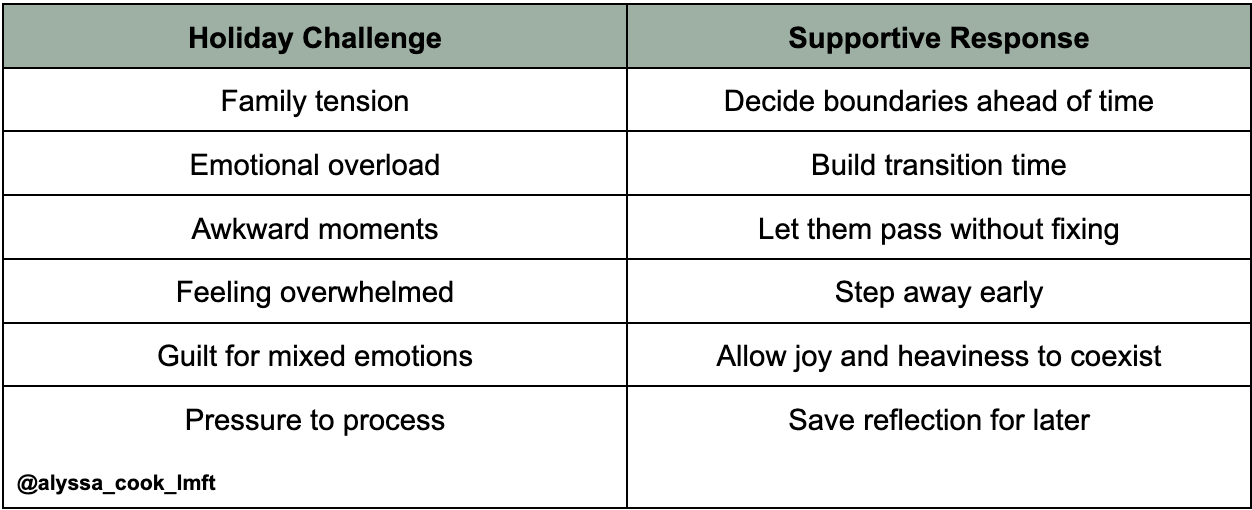
Decide Ahead of Time What You’re Not Available For
This is one of the most powerful holiday mental health tools—and one of the most overlooked.
Instead of deciding in the moment (when emotions are high), ask yourself before the holidays:
What conversations am I not willing to engage in?
How many events can I realistically attend?
What topics or dynamics tend to dysregulate me?
What drains me the fastest?
Examples of Boundaries You Can Set Ahead of Time
“I’m not available for political debates.”
“I’m not staying past a certain time.”
“I’m not explaining my life choices.”
“I’m not attending every event.”
Deciding ahead of time reduces guilt, anxiety, and emotional whiplash.
Let Awkward Moments Pass Without Fixing Them

This one is especially important for people-pleasers and overthinkers.
Not every awkward silence needs to be filled.
Not every comment needs a response.
Not every uncomfortable moment needs to be smoothed over.
Sometimes the healthiest response is… doing nothing.
Letting awkward moments pass without fixing them:
Preserves your energy
Reduces resentment
Interrupts people-pleasing patterns
You are not responsible for managing everyone else’s comfort.
Build in Transition Time Between Events
Back-to-back plans might look efficient on a calendar, but emotionally, they’re exhausting.
Transition time gives your nervous system a chance to reset.
What Transition Time Can Look Like
Sitting in your car for 10 minutes before going inside
Taking a short walk between events
Listening to music or a grounding podcast
Deep breathing or stretching
Think of transition time as emotional decompression, not wasted time.
Step Away Before You’re Overwhelmed
Many people wait until they’re already flooded before stepping away. By then, irritability, shutdown, or anxiety has already kicked in.
Try noticing your early signs of overwhelm:
Feeling tense or irritable
Zoning out
Shortness of breath
Urge to escape or shut down
Stepping outside or into another room before overwhelm peaks can make a huge difference.
You don’t need a dramatic exit. A simple “I’m going to grab some air” is enough.
Not Everything Needs to Be Processed in Real Time

This is a big one, especially for emotionally aware people.
Just because something triggers you doesn’t mean you need to analyze it right now.
Processing can wait.
Reflection can wait.
Meaning-making can wait.
Sometimes the most regulated choice is saying:
“I’ll come back to this later.”
You Can Hold Joy and Heaviness at the Same Time
This might be the most important holiday reminder of all.
You can:
Laugh and still miss someone
Enjoy a moment and still feel sad
Be grateful and still overwhelmed
Show up and still struggle
Holding joy and heaviness at the same time doesn’t mean you’re ungrateful. It means you’re honest.
A Quick Holiday Survival Breakdown
Managing Family Dynamics Without Losing Yourself
Family gatherings often activate old patterns.
You might notice yourself:
Slipping into old roles
Over-explaining
Freezing or fawning
Feeling like a younger version of yourself
None of that means you’ve “regressed.” It means your nervous system recognizes familiar dynamics.
Helpful Reminders
You don’t need to prove you’ve changed
You don’t need to educate anyone
You don’t need to win or convince
Sometimes the most powerful growth is responding differently—or not responding at all.

Lower the Bar (Seriously)
Holiday expectations tend to be wildly unrealistic.
Your home doesn’t need to look perfect.
Every tradition doesn’t need to be honored.
Every event doesn’t need your full energy.
Lowering the bar doesn’t mean you don’t care, it means you care about your well-being.
What If the Holidays Are Especially Hard This Year?
Some seasons hit harder than others.
If you’re navigating:
Grief
Infertility or pregnancy loss
Postpartum challenges
Relationship changes
Burnout or depression
It makes sense if this time feels heavier.
You’re allowed to opt for gentler holidays. Smaller plans. Quieter moments. More space.
How Therapy Can Support You During the Holidays
Therapy during the holidays isn’t just for crisis moments, it can be a grounding anchor.
A therapist can help you:
Prepare for triggering situations
Practice boundary-setting
Process grief and loss
Regulate anxiety and overwhelm
Release guilt around “shoulds”
Sometimes having a place to land after the holidays is just as important as preparing for them.

Surviving the Holidays Counts
You don’t need to love the holidays.
You don’t need to feel constant joy.
You don’t need to do it perfectly.
Getting through the season while staying connected to yourself counts.
If this year’s goal is simply to survive the holidays with a little more self-compassion and a little less self-abandonment, that’s more than enough.
And if you need support navigating this season, you don’t have to do it alone.

Postpartum Depression vs. Normal Adjustment: How to Tell the Difference
Adjusting to life with a newborn is overwhelming for every parent, but how do you know when it’s more than typical stress? This blog breaks down the difference between normal postpartum adjustment and postpartum depression, in a compassionate and relatable way.
Navigating Postpartum Emotions: What’s Normal and What’s Not

Bringing home a new baby is often described as magical, but for many parents, the experience feels more like a roller coaster of exhaustion, mood swings, and overwhelm. Between sleepless nights, endless feeding cycles, and adjusting to a completely new identity, it’s natural to feel off-balance.
But sometimes the struggle goes beyond "normal adjustment." Postpartum depression (PPD) is a real, common, and treatable condition, and knowing the difference matters. In this blog, we’ll explore what’s expected during postpartum recovery, what’s not, and how to tell when you may need extra support.
What Are Normal Postpartum Adjustment Challenges?
The postpartum period (often called the "fourth trimester") is filled with massive emotional, physical, and hormonal changes. Even in the best circumstances, it’s completely normal to experience:
Mood swings
Fatigue and overwhelm
Increased irritability
Crying spells
Self-doubt about parenting
Feeling disconnected from your pre-baby identity
Why These Normal Adjustments Happen

Adjusting to a newborn is demanding for many reasons:
Hormonal fluctuations: After delivery, estrogen and progesterone levels drop dramatically.
Sleep deprivation: Newborns don’t care about your circadian rhythm.
Identity shifts: You’re suddenly responsible for keeping a tiny human alive.
Physical recovery: Whether vaginal birth or C-section, the body is healing.
These challenges can feel overwhelming but typically improve with rest, support, and time.
What Is Postpartum Depression (PPD)?
Postpartum depression is a clinical condition that affects up to 1 in 7 birthing parents. It’s more intense, longer-lasting, and more disruptive than typical postpartum stress.
Common Symptoms of PPD:
Persistent sadness or emptiness
Loss of interest in activities
Difficulty bonding with the baby
Intense guilt or feelings of worthlessness
Anxiety or intrusive thoughts
Hopelessness
Trouble sleeping even when the baby sleeps
Changes in appetite
Thoughts of self-harm or harming the baby
PPD is not your fault. It’s caused by a mix of hormonal, environmental, and psychological factors.
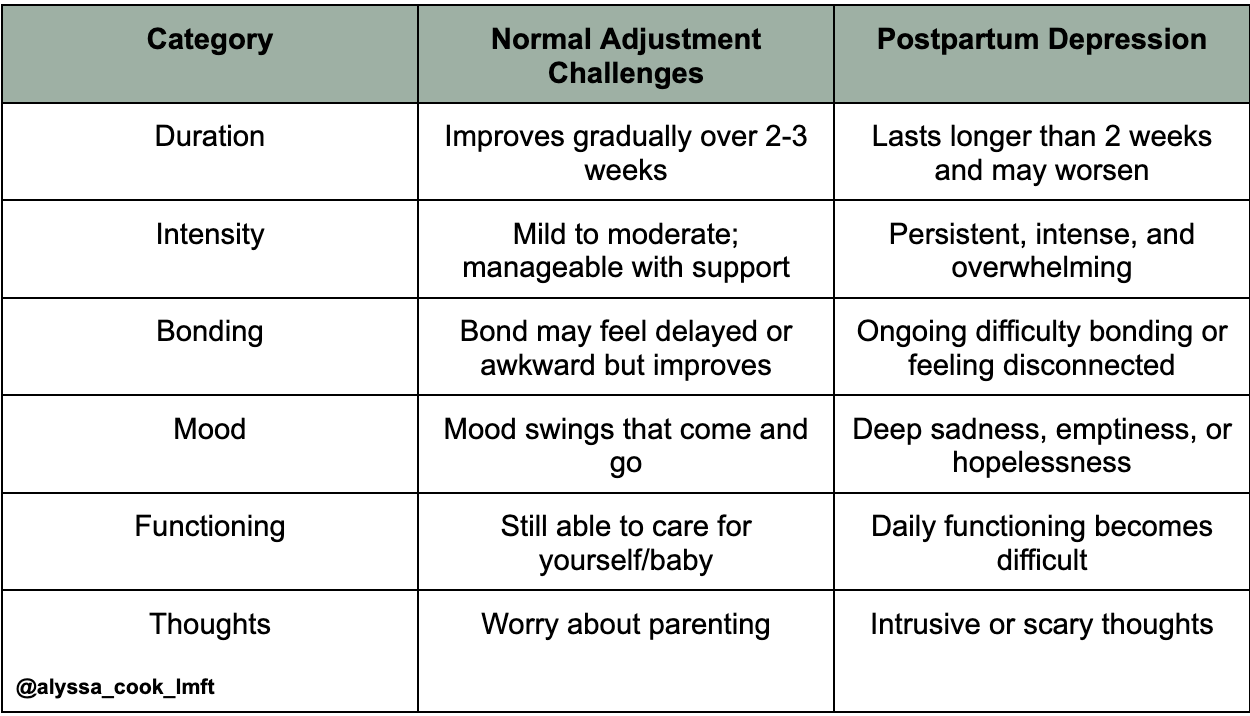
Key Differences: Normal Adjustment vs. Postpartum Depression
Here’s a simple breakdown to help illustrate the differences:
When Should You Seek Help?
If your symptoms:
last longer than two weeks,
interfere with daily functioning,
feel overwhelming or unmanageable,
or you’re experiencing intrusive or scary thoughts, it's time to reach out for help.
PPD is treatable with therapy, medication, support groups, or a combination of these.
Why Some People Are More Prone to PPD
There’s no single cause of postpartum depression, but risk factors include:
History of depression or anxiety
Traumatic birth experience
Lack of support from partner or family
Sleep deprivation
Hormonal sensitivity
NICU stay or medical complications
Previous pregnancy or infant loss
High expectations of self or perfectionism
Understanding these factors can help reduce shame and encourage early support.
How to Support Yourself Through Postpartum Recovery

Learning to care for yourself is essential, not selfish. Here’s how to support emotional health during the postpartum period:
1. Build a Support System
Accept help from friends, family, or postpartum doulas. Delegating tasks doesn’t make you less capable—it makes you human.
2. Prioritize Rest
Even short naps throughout the day can help restore emotional balance.
3. Connect with Other Parents
Support groups or parent-baby classes normalize the experience.
4. Lower Unrealistic Expectations
Your house doesn’t need to be spotless. Your baby doesn’t need a perfect routine. Good enough parenting truly is good enough.
5. Nourish Your Body
Hydration, balanced meals, and gentle movement can impact mood.
6. Create Moments of Self-Compassion
Use simple reminders like:
"I am learning."
"This phase is temporary."
"I deserve support, too."
When You’re Struggling: What Therapy Can Offer
Therapy can be incredibly helpful in the postpartum period, even if you’re not dealing with PPD. Working with a therapist gives you space to process identity changes, fears, relationships, and emotional overwhelm.
Therapists may use modalities like:
CBT to challenge intrusive thoughts
IFS to support overwhelmed internal parts
Mindfulness-based work to reconnect with the body
Emotion-focused therapy to process relationship shifts and communication
A therapist can help you build coping strategies, identify support needs, and reduce shame or isolation.
What About Partners?
Partners can also experience postpartum depression or anxiety, even without giving birth. Signs may include withdrawal, irritability, loss of interest, or feeling overwhelmed. The transition to parenthood impacts the whole family. Encourage partners to seek support if they’re struggling, you don’t have to navigate this alone.
Final Thoughts: You’re Not Failing, You’re Adjusting

Every parent experiences postpartum challenges. What you’re feeling doesn’t make you weak or inadequate, it makes you human. But if what you’re feeling goes beyond normal stress and starts impacting your ability to function, connect, or enjoy life, reaching out for help is one of the most loving things you can do for yourself and your baby. Postpartum depression is treatable, temporary, and nothing to be ashamed of. You deserve support, rest, compassion, and healing. If you're ready to talk to someone who understands postpartum mental health, I'm here to help you navigate this season with care and support.

Why Change Feels Hard: Understanding Your Brain and Learning to Adapt
Struggling to adjust to change? Whether it’s a new job, lifestyle shift, or personal growth, your brain is wired to resist. This blog explains why change feels so hard and offers practical, compassionate strategies to help you adapt more smoothly.
Why Your Brain Resists Change and How to Help It Adjust

We all know change is a part of life, but let’s be real, it often feels really hard. Even when we’re making positive changes, like starting a new job, committing to healthier habits, or moving to a new city, there’s usually a part of us that just wants to run back to the comfort of what we already know. Why does that happen?
The short answer: your brain is wired for safety and predictability, not uncertainty. But here’s the good news is you can learn to work with your brain rather than against it.
In this blog, we’ll explore why your brain struggles with change, how it impacts your daily life, and the practical steps you can take to gently guide yourself through transitions.
Why Does the Brain Resist Change?
Change triggers our brain’s alarm system. Even if a change is positive, your brain may interpret it as a potential threat. Here are the main reasons why:

1. The Comfort of Familiarity
Your brain loves patterns. Familiar routines create a sense of safety because you know what to expect. Breaking a habit, even for something better, means stepping into the unknown.
2. Fear of the Unknown
The brain interprets uncertainty as risky. When you don’t know how things will turn out, your stress response can kick in, flooding your body with anxiety or resistance.
3. Energy Conservation
Creating new neural pathways takes effort. Your brain is always trying to conserve energy, so it prefers sticking to well-worn patterns rather than building new ones.
4. Emotional Associations
If you’ve experienced stressful or painful changes in the past, your brain may associate “change” with danger or loss, even if the current change is safe and positive.
How Resistance to Change Shows Up in Daily Life
When your brain struggles with change, it can look like procrastination, avoidance, or even self-sabotage. Here are some common signs:
Feeling overwhelmed or anxious when thinking about the change
Procrastinating or delaying action
Overthinking or second-guessing decisions
Clinging to old routines even when they no longer serve you
Experiencing physical tension, fatigue, or disrupted sleep
A Gentle Approach: How to Work With Your Brain During Change

The key is not to force yourself into change with willpower alone, but to work gently with your brain’s natural wiring.
1. Start Small
Breaking change into smaller steps helps reduce overwhelm. For example, if you’re trying to start exercising, begin with a 10-minute walk rather than committing to an hour at the gym.
2. Create Predictability Within Change
Even small routines provide a sense of stability. If you’ve moved to a new city, establishing a morning ritual can anchor you while you adjust.
3. Normalize Discomfort
Remind yourself: discomfort doesn’t mean something’s wrong. It just means your brain is adjusting.
4. Use Self-Compassion as a Tool
Instead of criticizing yourself for struggling, acknowledge that resistance is a normal part of growth. Try saying, “It makes sense that this feels hard. I’m learning something new.”
5. Celebrate Progress, Not Perfection
Notice and reward yourself for the small wins. This helps reinforce positive changes and motivates your brain to keep going.
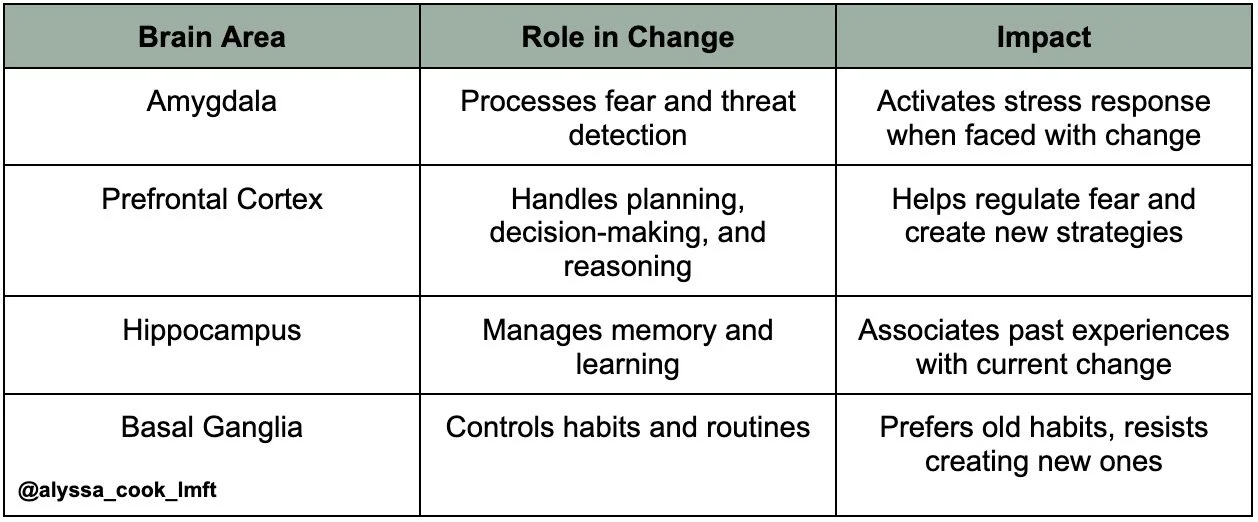
A Look at the Brain’s Response to Change
Here’s a quick breakdown of how the brain processes change:

When Change Feels Overwhelming
Sometimes resistance to change goes beyond everyday discomfort. If you notice that fear or avoidance is deeply interfering with your life, it may be worth seeking support. A therapist can help you:
Understand your resistance more deeply
Build coping strategies tailored to you
Process past experiences that may be influencing your present
You’re Not Broken for Struggling With Change
Struggling with change doesn’t mean you’re weak or incapable, it means you’re human. Your brain is doing its best to keep you safe, even if it sometimes works against your goals. By approaching change with patience, compassion, and practical strategies, you can re-train your brain to embrace growth while still feeling grounded.
So the next time you feel resistance bubbling up, take a deep breath. Remind yourself: It’s okay that this feels hard. Then, choose one small step forward. That’s how change becomes not just possible, but sustainable.

Quieting the Inner Critic: How to Shift Your Self-Talk and Build Self-Compassion
Your inner critic is that harsh voice in your head that says you're not good enough. Learn how to identify it, respond with self-compassion, and develop a healthier inner dialogue.
Understanding Your Inner Critic and How to Talk Back

We all have that voice in our head—the one that chimes in when we mess up, feel unsure, or try something new. “You’re not good enough.” “Why did you say that?” “You’ll never get it right.” This voice is often referred to as the inner critic, and while it might sound like it’s trying to keep us safe, it often causes more harm than good.
In this blog, we’ll unpack what the inner critic is, where it comes from, and how to respond to it differently. We’ll also explore the empowering alternative: the inner coach. If you're ready to turn down the volume on self-judgment and turn up the self-compassion, you're in the right place.
What Is the Inner Critic?
The inner critic is the internal voice that judges, shames, and doubts us. It’s the part of our mind that points out our flaws, magnifies our mistakes, and predicts failure. The inner critic might sound like:
“You always mess things up.”
“Why can’t you be more like them?”
“No one is going to take you seriously.”
Where Does the Inner Critic Come From?

The inner critic often develops early in life as a way to cope with difficult environments or meet the expectations of caregivers, teachers, or society. While it may have once served a protective purpose, it tends to become overactive and unhelpful in adulthood.
Common sources of the inner critic include:
Childhood criticism or unrealistic expectations
Trauma or neglect
Cultural or societal pressures
Perfectionism
The Impact of the Inner Critic on Mental Health
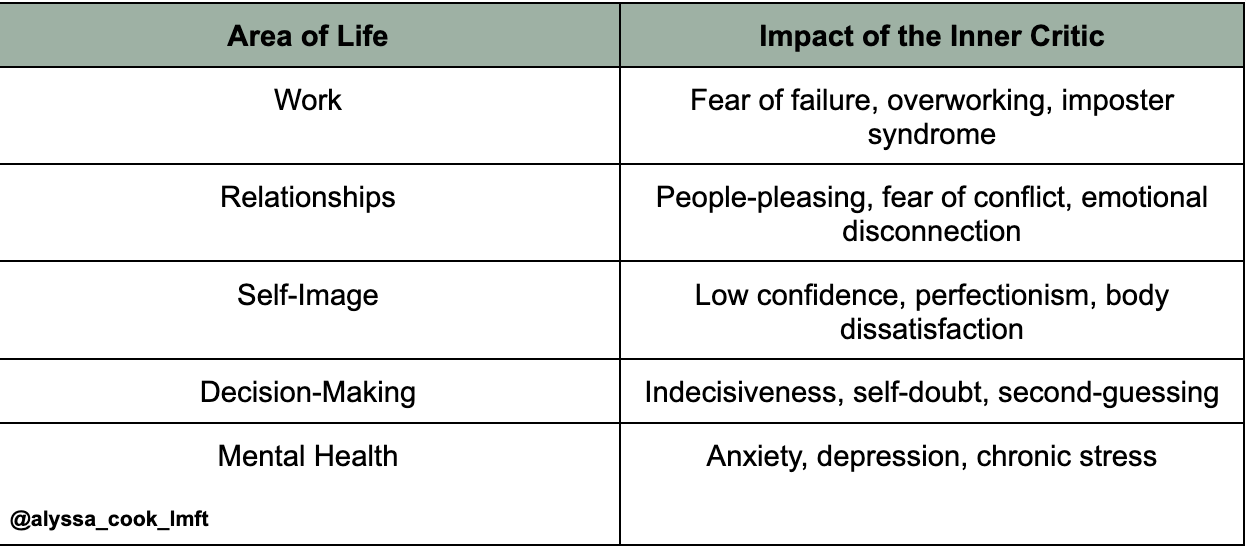
When left unchecked, the inner critic can fuel issues like anxiety, depression, low self-esteem, and burnout. It can keep you stuck in fear, people-pleasing, or procrastination.
How the Inner Critic Affects You
Recognizing the Voice of Your Inner Critic
The first step in healing your relationship with your inner voice is becoming aware of it. Start noticing when your self-talk is harsh, judgmental, or unkind. Ask yourself:
Would I say this to someone I care about?
Does this voice motivate me—or shut me down?
Where did I learn to talk to myself this way?
Keeping a journal or thought log can be a powerful tool to bring these thoughts into the light.
Inner Critic vs. Inner Coach
Let’s introduce a healthier voice: the inner coach. Unlike the inner critic, the inner coach is supportive, realistic, and encouraging. It doesn’t pretend everything is perfect—it just doesn’t tear you down.
Key Differences
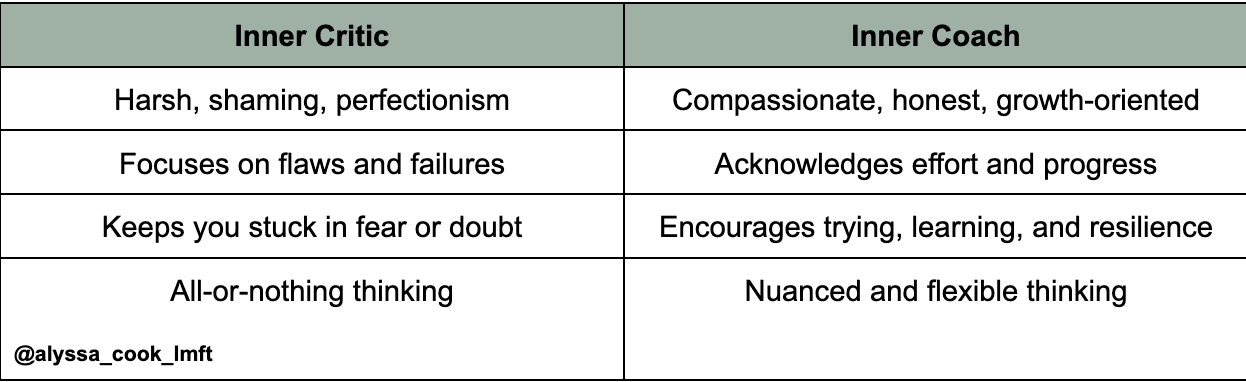
You can start to shift your inner narrative by learning how to replace critical thoughts with more compassionate ones.
How to Respond Differently: Practical Strategies
Changing your inner dialogue takes time and practice, but it’s absolutely possible. Here are some techniques that can help:
1. Name Your Inner Critic
Give it a name or identity—like "The Perfectionist," "The Worrier," or even something playful like “Judgey McJudgeface.” Naming helps you create some distance and notice when it's showing up.
2. Use the ABC Model
Adapted from CBT (Cognitive Behavioral Therapy):
A – Activating event: Something happens (e.g., you make a mistake at work)
B – Belief: “I’m terrible at my job.”
C – Consequence: You feel anxious and avoid taking initiative
Challenge the belief by asking: What’s the evidence for and against this? What would I say to a friend in this situation?
3. Reframe the Thought
Reframe “I always fail” into “This was hard, but I’m learning.” Turn “I’m not enough” into “I’m doing the best I can right now.”
4. Practice Self-Compassion
This means speaking to yourself with kindness, especially when things don’t go as planned. Try:
“It’s okay to make mistakes.”
“This is tough, and I’m not alone.”
“I can learn and grow from this.”
5. Talk Back in Writing
Write a letter from your inner critic—and then write a letter in response from your inner coach or compassionate self. This is a powerful exercise to externalize the negative voice and offer yourself support.
6. Use Affirmations (That Actually Work for You)
Not cheesy, fake-positive ones—but grounded ones that resonate. Try:
“I am learning to be kind to myself.”
“Progress matters more than perfection.”
“I can hold space for my flaws and my strengths.”
When the Inner Critic Gets Loud: Triggers to Watch For

Certain situations can make the inner critic more vocal. Being aware of these can help you catch it in action.
Common triggers include:
Transitions (new job, new relationship)
Feedback or perceived failure
Social comparison
High-stress or burnout
Feeling emotionally vulnerable
Notice your patterns—then bring in your inner coach.
How Therapy Can Help
You don’t have to navigate this work alone. A therapist can help you:
Recognize and challenge core beliefs
Understand the origins of your inner critic
Build a toolbox of self-compassion and coping skills
Practice skills like thought reframing and self-validation
Modalities like CBT, IFS (Internal Family Systems), and ACT (Acceptance and Commitment Therapy) are especially helpful when working with the inner critic.
Small Daily Practices to Rewire Your Inner Dialogue
Healing your inner narrative doesn’t happen overnight—but consistent, gentle practice makes a difference. Try adding some of these into your routine:
Start your day with a grounding affirmation
Take 60 seconds to notice and name your thoughts
Journal one thing you’re proud of each day
End your day with a self-compassion check-in: “What did I need today that I didn’t get?”
Final Thoughts: You Are Not Your Inner Critic

The inner critic might always be part of your mental landscape—but it doesn’t have to take the wheel. With awareness, practice, and support, you can build a new way of relating to yourself that’s rooted in compassion and courage.
You are not broken for having an inner critic. You are human. And you have the power to choose a different voice—the voice of your inner coach, your wise self, your compassionate inner healer.
If you’re ready to get support in quieting your inner critic and building a stronger, more supportive inner voice, therapy can be a powerful place to start. Reach out if you’d like to talk more!

Breaking the Cycle: Understanding and Overcoming Avoidance Behavior
Avoidance behavior might seem like a way to stay comfortable, but in the long run, it keeps you from growth, success, and emotional well-being. This blog breaks down why we avoid things, how it impacts our lives, and most importantly—what we can do about it.
Why We Avoid Things (And How to Stop)

We all do it—put off difficult conversations, dodge responsibilities, or distract ourselves when things get overwhelming. Avoidance behavior is a natural response to discomfort, but when it becomes a pattern, it can create anxiety, stress, and even bigger problems down the road.
If you’ve ever found yourself deep in a Netflix binge instead of handling an important task, or going out of your way to avoid a difficult situation, this article is for you. Let’s explore what avoidance behavior really is, why we do it, and how to break free from its grip.
What Is Avoidance Behavior?
Avoidance behavior happens when we dodge situations, emotions, or responsibilities that feel uncomfortable or threatening. It’s often linked to anxiety, stress, or past negative experiences, and while it may bring short-term relief, it usually leads to long-term consequences.
Common Types of Avoidance
Avoidance can show up in different ways. Here are a few of the most common forms:

Why Do We Avoid Things?
There are a few psychological reasons why we lean on avoidance behavior. Understanding these can help us begin to shift our habits.

1. Fear of Discomfort or Failure
Many of us avoid things because we anticipate they’ll be uncomfortable or we’re afraid we won’t do well. This is especially true for tasks that require effort, vulnerability, or uncertainty.
2. Anxiety and Overwhelm
When our brains perceive something as stressful, they trigger a fight-or-flight response. Avoidance is a form of “flight.” By dodging the situation, we feel temporary relief, but the stress often comes back stronger later.
3. Habit and Conditioning
If we’ve been avoiding difficult things for a long time, it becomes second nature. We don’t even think about it—we just automatically dodge situations that seem tough.
4. Negative Past Experiences
If something went badly in the past, we may unconsciously avoid similar situations in the future. For example, if you failed a big test in school, you might avoid taking on new learning opportunities as an adult.
The Consequences of Avoidance
Avoidance may feel good in the moment, but it can have some serious downsides, including:
Increased Anxiety – The more we avoid something, the scarier it feels over time.
Missed Opportunities – Avoiding challenges means missing chances for growth and success.
Strained Relationships – Avoiding conflict or difficult conversations can lead to unresolved issues.
More Stress in the Long Run – Problems don’t go away just because we ignore them. They often get worse.

How to Break the Cycle of Avoidance

If avoidance has been holding you back, the good news is that you can break the cycle. Here’s how:
1. Start Small
Tackling big fears head-on can feel overwhelming, so start with small steps. If you avoid phone calls, try answering one today. If you dodge difficult conversations, start with a text or email.
2. Name Your Avoidance
Awareness is the first step to change. Notice when you’re avoiding something and say it out loud: “I’m avoiding this because it feels uncomfortable.” This simple act can help you take control.
3. Challenge Your Thoughts
Ask yourself: What’s the worst that could happen? and How likely is that really? Our brains often exaggerate the risks of facing something difficult.
4. Use the “5-Minute Rule”
If you’re avoiding a task, commit to doing it for just five minutes. Often, once you start, it’s easier to keep going.
5. Practice Exposure Therapy
Exposure therapy is a psychological technique that involves gradually facing what you fear in a controlled way. If you’re afraid of public speaking, for example, start by talking in front of a mirror, then to a friend, then a small group.
6. Build Emotional Resilience
Instead of running from uncomfortable emotions, practice sitting with them. Mindfulness, meditation, and journaling can help you become more comfortable with discomfort.
7. Seek Support
If avoidance is significantly impacting your life, therapy can help. A therapist can work with you to uncover the root causes and develop strategies to move forward.

Final Thoughts
Avoidance behavior is common, but it doesn’t have to control your life. By understanding why we avoid things and taking small steps to face discomfort, we can break free from the cycle and start living more fully.
The next time you catch yourself avoiding something, pause and ask: What’s one small step I can take right now? Change doesn’t happen overnight, but every step forward makes a difference.
Need extra support? Working with a therapist can help you navigate avoidance behavior and develop healthier coping strategies. If you're ready to take that step, click the button below to get started!

How Attachment Styles Impact Adult Relationships
Your attachment style shapes how you connect with others, handle intimacy, and respond to emotional needs in relationships. Understanding your attachment style—whether secure, anxious, avoidant, or disorganized—can help you build healthier, more fulfilling connections. In this post, we’ll break down each style, how they show up in adulthood, and how to navigate relationships more effectively.

Understanding Your Attachment Style and How It Affects Your Relationships
Have you ever wondered why you react a certain way in relationships? Why some people seem so secure while others struggle with trust, intimacy, or independence? Attachment theory offers valuable insights into how we connect with others based on our early experiences with caregivers. These patterns, known as attachment styles, shape the way we navigate adult relationships—whether romantic, platonic, or professional. In this blog, we’ll break down the four main attachment styles, how they influence your relationships, and what you can do to develop a more secure attachment over time.
What Are Attachment Styles?
Attachment styles are patterns of relating to others, developed in early childhood based on interactions with caregivers. Psychologists John Bowlby and Mary Ainsworth pioneered this concept, which has since been widely used to understand human relationships.
The Four Main Attachment Styles
To better understand how attachment styles impact adult relationships, let’s break them down into a simple table:

How Each Attachment Style Impacts Adult Relationships
Secure Attachment: The Foundation of Healthy Relationships
People with a secure attachment style tend to have stable, fulfilling relationships. They are comfortable giving and receiving love, communicate openly, and handle conflicts with emotional maturity. If you have this style, you likely:
Feel at ease with emotional intimacy and independence
Trust your partner and expect the same in return
Manage conflicts constructively
What to work on: Even those with a secure attachment can face challenges. If you notice struggles, focus on continuing to communicate openly and setting healthy boundaries.

Anxious Attachment: Seeking Constant Reassurance
If you have an anxious attachment style, relationships may feel like an emotional rollercoaster. You crave closeness but often fear your partner will leave you. Common traits include:
Feeling insecure and needing frequent validation
Overanalyzing texts and interactions
Feeling rejected easily
How to grow: Work on self-soothing techniques, mindfulness, and learning to trust yourself rather than relying on a partner for validation. Therapy can be beneficial in helping you develop a sense of inner security.
Avoidant Attachment: Keeping People at a Distance
If you lean toward an avoidant attachment style, emotional intimacy might feel uncomfortable. You value independence and may push people away if they get too close. Signs of avoidant attachment include:
Preferring emotional distance in relationships
Struggling to express feelings
Feeling suffocated by too much closeness
What to work on: Practice emotional vulnerability and open communication. Relationships require balance—learning to lean on others doesn’t mean losing independence.
Disorganized Attachment: ThePush-Pull Struggle
A disorganized attachment style can feel like an internal battle—wanting closeness but fearing it at the same time. It often stems from trauma or inconsistent caregiving in childhood. Common traits include:
Fear of getting hurt but also fear of being alone
Mixed signals in relationships
Difficulty trusting others
How to grow: Self-awareness is key. Therapy, journaling, and learning to recognize patterns can help break the cycle and move toward a more secure attachment.
INFOGRAPHIC
How to Develop a More Secure Attachment Style
The good news? Attachment styles aren’t set in stone. With awareness and effort, you can move toward a more secure way of relating to others. Here are some steps to help:

1. Build Self-Awareness
Identify your attachment style by reflecting on past relationships.
Notice triggers—what makes you feel insecure or distant?
Journaling can help track patterns and emotions.
2. Challenge Negative Beliefs About Relationships
If you have anxious attachment, remind yourself that love isn’t about constant reassurance.
If you have avoidant attachment, challenge the belief that depending on others is a weakness.
3. Strengthen Communication Skills
Practice expressing feelings openly without fear.
Learn to ask for what you need in relationships.
Set healthy boundaries to avoid extremes of over-dependence or emotional withdrawal.
4. Work With a Therapist
Therapy is a great space to explore attachment wounds and develop healthier relationship patterns. A therapist can help:
Identify deep-rooted fears and triggers
Develop emotional regulation skills
Create new patterns for more fulfilling relationships

Moving Toward Healthier Relationships
Understanding your attachment style is a powerful step toward building better relationships. Whether you’re navigating romantic partnerships, friendships, or family dynamics, knowing how you connect with others allows you to make intentional changes. The goal isn’t perfection—it’s awareness, growth, and creating connections that feel fulfilling and safe.
If you’re struggling with attachment wounds or relationship challenges, therapy can be an excellent resource. Working with a professional can help you develop a secure attachment and experience healthier, more satisfying relationships.
Looking for support? If you’re ready to explore your attachment style and work toward healthier relationships, click the button below to set up a free consultation!

Getting Organized When You Have Anxiety
Feeling overwhelmed by anxiety and disorganization? You're not alone! This guide will provide practical and relaxed tips to help you get organized, reduce stress, and create a more manageable routine. Dive in for expert advice and helpful strategies from a therapist's perspective.

Understanding the Link Between Anxiety and Disorganization
We all know that anxiety can make even the simplest tasks feel overwhelming. When you're constantly juggling worries and stress, staying organized can seem like an impossible feat. But fear not! As a therapist, I've worked with many clients facing the same struggle. In this blog, I'll share some practical, casual, and relaxed tips to help you get organized, even when anxiety is getting in the way.
How Anxiety Impacts Organization
Anxiety can cause a whirlwind of thoughts, making it hard to focus on tasks at hand. This often leads to disorganization, which in turn can heighten anxiety—creating a vicious cycle. When you're anxious, your brain is in overdrive, constantly jumping from one worry to the next. This can make it difficult to plan, prioritize, and stay on top of things.
Personal Experience with Anxiety and Organization
I get it. I've been there too, feeling like I'm drowning in a sea of to-do lists and deadlines. But the good news is, there are ways to manage both your anxiety and your organizational skills. It just takes a bit of patience, practice, and the right strategies.

Practical Tips for Getting Organized
Start with a Brain Dump
One of the best ways to start getting organized is by doing a brain dump. This simply means getting all your thoughts, tasks, and worries out of your head and onto paper. It can be incredibly freeing and give you a clearer picture of what needs to be done.
How to Do a Brain Dump
Find a Quiet Space: Sit somewhere quiet where you won't be interrupted.
Write It All Down: Grab a pen and paper, and write down everything that's on your mind. Don't worry about organizing it just yet.
Review and Prioritize: Once everything is down on paper, review your list and start to prioritize. What needs to be done today? What can wait?
Creating a Realistic To-Do List
Keep It Simple
When creating a to-do list, it's important to keep it simple and realistic. Avoid overwhelming yourself with too many tasks. Focus on the most important and urgent items first.
Tips for an Effective To-Do List
Limit Your Tasks: Aim for no more than 5-7 tasks per day.
Break Down Big Tasks: If a task feels too big, break it down into smaller, more manageable steps.
Use Positive Language: Instead of writing "Don't forget to..." use positive language like "Remember to..."
Setting Up a Routine
The Power of Routine
Routines can provide structure and predictability, which can be very soothing for an anxious mind. A good routine helps you know what to expect, reducing the mental load of decision-making throughout the day.
Creating Your Routine
Morning Routine: Start your day with a consistent morning routine. This could include activities like a short meditation, a healthy breakfast, or a quick workout.
Work Routine: Set specific times for work tasks and breaks. Use tools like the Pomodoro Technique to stay focused.
Evening Routine: Wind down with a relaxing evening routine. This could involve reading, journaling, or a warm bath.

Using Tools and Apps
Digital Tools for Organization
There are numerous apps and tools designed to help you stay organized. Find the ones that work best for you and your lifestyle:
Trello: Great for project management and keeping track of tasks.
Todoist: A user-friendly to-do list app.
Evernote: Perfect for note-taking and organizing ideas.
Physical Tools for Organization
If digital tools aren't your thing, there are plenty of physical tools that can help you stay organized:
Planner: A physical planner can help you keep track of your schedule and to-do lists.
Bullet Journal: A flexible and customizable way to organize your tasks and thoughts.
Whiteboard: Great for visualizing your tasks and priorities.
Decluttering Your Space
The Importance of a Clean Space
A cluttered space can contribute to a cluttered mind. Taking the time to declutter and organize your physical space can have a significant impact on your mental clarity and reduce anxiety.
Tips for Decluttering
Start Small: Begin with one area, like your desk or a single drawer.
Set a Timer: Give yourself a set amount of time to declutter, like 15-30 minutes.
Use the Four-Box Method: Label four boxes: Keep, Donate, Trash, and Relocate. Sort your items accordingly.
Practicing Mindfulness
The Benefits of Mindfulness for Anxiety
Mindfulness involves staying present and fully engaging with the current moment. Practicing mindfulness can help you manage anxiety and improve your focus, making it easier to stay organized.
Simple Mindfulness Practices
Mindful Breathing: Take a few minutes each day to focus on your breath. Inhale deeply through your nose, hold for a few seconds, and exhale slowly through your mouth.
Body Scan: Lie down or sit comfortably. Close your eyes and bring your attention to different parts of your body, starting from your toes and moving up to your head.
Mindful Walking: Take a walk outside and pay attention to your surroundings. Notice the sights, sounds, and smells.

Seeking Support
Don’t Be Afraid to Ask for Help
Sometimes, getting organized can feel overwhelming, especially when you're dealing with anxiety. It's important to remember that it's okay to ask for help:
Friends and Family: Reach out to loved ones who can offer support and encouragement.
Therapists and Counselors: A therapist can help you develop strategies to manage anxiety and stay organized.
Support Groups: Consider joining a support group for people dealing with anxiety. Sharing your experiences and hearing from others can be incredibly beneficial.
Building Healthy Habits
The Role of Healthy Habits in Organization
Building healthy habits can create a strong foundation for staying organized. When you take care of your physical and mental health, you're better equipped to handle daily tasks and reduce anxiety.
Healthy Habits to Incorporate
Regular Exercise: Aim for at least 30 minutes of physical activity most days of the week.
Balanced Diet: Eat a variety of nutritious foods to fuel your body and mind.
Adequate Sleep: Prioritize getting 7-9 hours of sleep each night.
You’ve Got This!
Getting organized when you have anxiety can be challenging, but it's definitely doable. By implementing these strategies and taking things one step at a time, you can create a more manageable routine and reduce your stress levels. Remember, it's all about finding what works best for you and being kind to yourself along the way. If you have any questions or need further support, feel free to reach out—I’d love to hear from you!